


“So Marie Antoinette is absolutely a classic example of somebody who absorbs this cult of sensibility, you know, nature, simplicity, all of these things, intense feeling, tenderness, friendship, family.”
“And also the idea that if you obey the impulses of your emotions, that will lead you to truth.”
“Yeah.”
“So it’s kind of bizarre, isn’t it, that simultaneously it’s an age of reason, but it’s also an age of intense feeling.”
“So those things are in tension.”
“Well, there is a tension there, but there seems to be an assumption that there isn’t.”
These are Dominic Sandbrook and Tom Holland discussing an aspect of the French Revolution in an episode of their spectacularly successful podcast The Rest is History. This segment sketches part of the milieu of the 1780’s, though arguably that milieu encompasses a significantly longer stretch of time.
One challenge is to identify what the description helps to characterize. Is it the psychology of the era? Does that psychology apply to specific individuals, or is there a body politic to which one can ascribe psychological forces? Then again, perhaps the description captures intellectual developments, including quite specific philosophical arguments? Or is there, yet again, some other entity such as “culture” or Zeitgeist (spirit of the age) to which the notion of reason-and-emotion-in-tension gives access? Perhaps it might apply in one way to the aristocracy and in another to the masses?
In the podcast, the sketch in these terms lasts for only a few moments of an hour-long episode of an eight-part series that covers the beginning phase of an episode in French history to which they will devote two further multi-part series. Far be it from these historians to overplay their hand in one direction. They are nothing if not measured when it comes to the complex, manifold causes, events, and consequences of the French Revolution in Western European and world history.
Nonetheless, they give a significant nod to love-and-reason-in-tension. They will do further work along these lines too, for instance when Tom discusses the ideals of the Revolution and makes the case that abstract nouns (like liberty, equality, and fraternity) matter. The notion of reason and feeling in tension likewise would seem to matter. At the very least, the construct serves as a sign of the complexities and even the apparent contradictions of the time period. It serves as a warning in the study of this history and in the study of history generally to account for rather nebulous factors among others like the price of bread, the influence of the printing press, the weather, factionalism, personalities, and so on.
In as succinct and suggestive a way as possible, Sandbrook and Holland want to draw attention to the paradoxical nature of the intellectual and psychological forces at play in the sphere of French politics in this time period. The phrase “The Age of Reason” is iconic. It refers to an increasing trust among many Western European intellectuals in humanity’s own resources, especially over and against superstition, tradition, and religion. Descartes championed the thinking self (“I think, therefore I am”) and later Kant identified a motto for the Enlightenment (Sapere aude! Dare to think!).
Some of the same intellectual forces led to developments in different directions, including an increased emphasis on naturalism, emotion, sensibility (awareness of the senses over and against the intellect), and bodily expression. A leading influence along these lines was Jean-Jacques Rousseau, who wrote about the social contract in keeping with a commitment to individualism and naturalistic ideals in education.
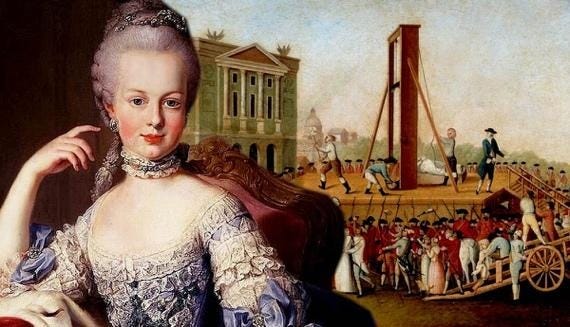
This tension leads Dominic (in particular) to present an arresting thesis about Marie Antoinette. Her own adherence to the cult of sensibility complicates the standard narrative. The latter embellishes her disdain and detachment, her treacherous manipulation of people and circumstances as an Austrian outsider, even (in the language of the day) accusations of her unnatural relations. For Dominic and Tom, her commitment to the cult of sensibility undermines a caricature that reduces her to an aristocratic figure of contempt.
Part of the cultural work of love-and-reason-in-tension is to contribute to historical explanation well-told. If we were to imagine a spectrum with analysis of reason in the thought of Descartes and Rousseau at one end and pacy storytelling at the other, we could readily agree that the trope in the hands of The Rest is History serves the latter effect more than the former. It functions especially well rhetorically. At the same time, it encourages the curious listener to undertake further investigation for themselves.
Holland and Sandbrook understand, perhaps intuitively, that a little goes a long way. They also recognize that a tension between reason and emotion or sensibility has inherent value. It helps explain the circumstances. The construct is also identifiable to their intended audience: it’s the water we swim in. I find myself wondering, does love-and-reason-in-tension come to life in a particular way among the ideals of liberty, republicanism, and individual rights of the French Revolution? Is it a marker of our deepest held Western political assumptions?