


Q. Excuse me, what is a floating dome?
A. Soane didn’t care about form, he was all about emotion.
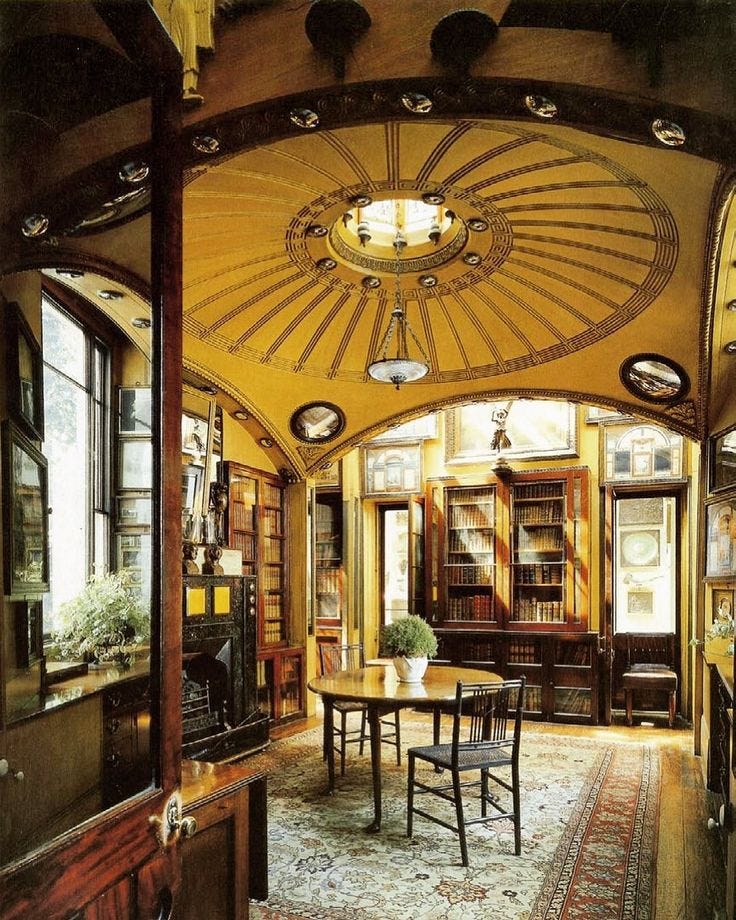
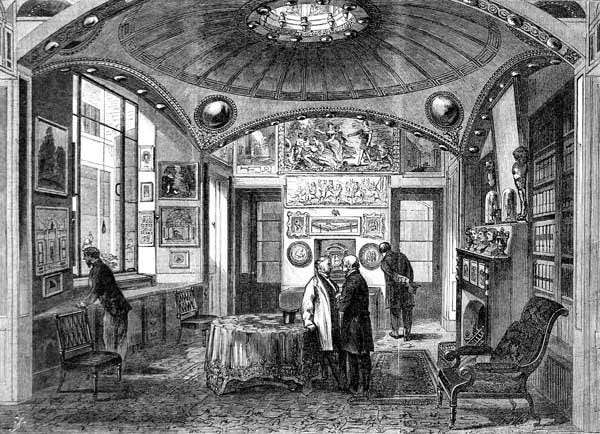
Nineteenth-century architect John Soane (1753–1837) turned his London home into a living example of the sorts of things he could do architecturally. Eventually becoming professor of architecture at the Royal Academy, he did so for clients and students alike. Upon his death and according to his detailed instructions, his home became the museum it is to this day.
A sign in the breakfast room says that the room boasts a floating dome. What’s a floating dome? While visiting the museum, I heard the question put to an attendant. The volunteer, an architecture student himself, answered in a striking way. Rather than provide even a rudimentary technical understanding of the phrase “floating dome,” he apparently thought to cut to the chase of what really mattered to the great historical figure. He gave the answer quoted above: “Soane didn’t care about form, he was all about emotion.”
I personally was interested in a different sort of response because, presumably like the questioner, I too had no idea what made a dome “float.” I have since discovered that a dome is said to be floating when the building in which it is found doesn’t rely on it structurally. The dome is therefore simply for effect, an emotional effect. Formally, a non-floating dome does the work of supplying a roof for a structure and integrating the forces of its walls or pillars. They are holding it up and it, in its turn, is giving stability and coherence to the whole. Something like that. (If you google “floating dome,” you’ll get pictures of geodesic domes on water, so the phrase may be a term of art, and perhaps a British one at that.)
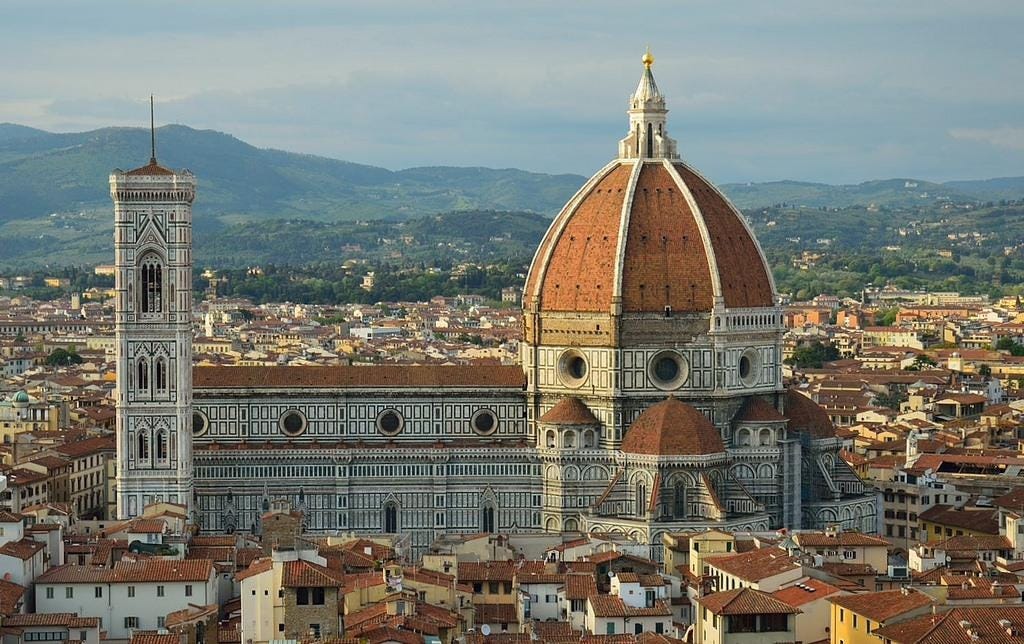
I’m reminded of Brunelleschi’s dome atop the awe-inspiring Duomo in Florence. Brunelleschi invented a brickwork pattern called spina di pesce (herringbone) to make the structure self-supporting. The dome also relies on a heavy lantern, the top part that pokes up. The downward force of the lantern helps keep everything in place. The dome is functionally integral, the opposite of floating, at least in the sense of the term of art as used in the John Soane Museum. Of course, on a sultry summer day, viewed from one of the nearby hills the duomo absolutely appears to float, but that’s something else again.
Among his achievements, Soane was awarded the contract for the Bank of England, a building he completed in 1833. It had domes and arches in it. Strictly speaking, it wasn’t true that he was “all about emotion” or didn’t care about form. He couldn’t have succeeded as an architect had that been literally true. Yet the point stands. The student was making the case for a particular understanding of Soane’s architectural achievement and he was appealing to reason-and-emotion-in-tension to do so. The trope was doing cultural and interpretive work.
I am here revisiting a theme I have touched on in a post (not for Traces) about the Golden Gate Bridge. I commented on how Ted Danson’s character in Man on the Inside, a retired engineer, augments function with form. In that instance, form provides “the beating heart” to the engineering accomplishment, making the bridge much more than merely rationally “useful.” In the case of the attendant’s not dissimilar but flipped evocation, “form” has become the word associated with reason: the prosaic necessities for holding something up and the head scratching, the mathematical formulas, and the knowledge of materials to go along with that. The passion of the project has shifted away from form to emotion, and with the latter the inference of heartfelt creativity.
In other words (if I may interpret the attendant freely) Soane, like the engineer responsible for the Golden Gate Bridge, could not rest content with mere utility. Context is necessary to understand the meaning of the terms, but the appeal to a tension between reason and emotion, perhaps even reason and love, is similar.
Would it be pedantic to say that the attendant was prising reason and emotion apart? He may have said what he said mostly for effect, because he found the question boorish. His gnomic remark may have issued from disdain at a lack of rudimentary knowledge of architectural terms of art. However, it may have been enflamed by a perceived literalism on the part of the questioner that evinced little interest in emotion and creativity in architecture. He was damned if he was going to cater to terminological rationalism.
More seriously, though, the student’s suggestion of a strict opposition presumed architecture as a zero-sum conflict in which reason was always to be subordinated to emotion. Paradoxically, this felt like a downgrading of love as well. Love is always fascinated by the particularities of a lived situation and the demands, sometimes moral, always intellectual, that a work requires.