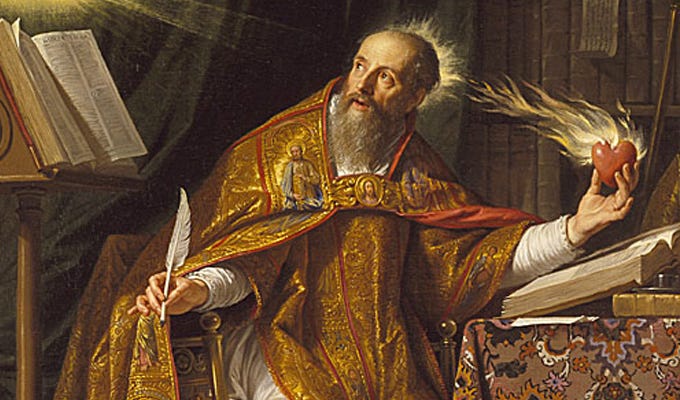
Last time I wrote about language as a synonym for knowing. The critic Terry Eagleton has pointed out that language is more than a tool with meaning lying behind the words used. Language involves form, which at the very least implies tone, or a blend of intellectual and emotional content.
I hinted that Eagleton the Marxist (and quite possibly a materialist) might not go far enough by positing a tension in language between reason and emotion. Augustine goes farther. “Speeches of the heart” is a phrase that this ancient Christian pastor derives from the gospels and ponders in the climactic book of his great treatise On the Trinity. He works out an unprecedented theory of language under the auspices of incarnational-trinitarian thinking. (It far surpasses his own “theory of signs” in On Christian Doctrine.)
If you’ve read Augustine out of a sense of obligation, Confessions say, or chunks of The City of God, you may have overlooked one of the most obvious characteristics of his writing in your quest for the greatness of the great books: Augustine has a philosophical mind. That is to say, there’s no telling what detail he will make strange and on which he will concentrate his powers. By all means, be moved by the prayerfulness of his dialogue with God and the grandeur of his vision of history. Still, come back to Augustine again when you’re not inclined to find exalted distraction tedious.
“Speeches of the heart” sounds not only biblical but poetic. Yet Augustine is after more than colour or possible irony. The rhetorician is in search of a theory of language to do justice to John 1:1–14. For a long time now in the De Trinitate, he has been talking about things we know – things in the world around us like an old word for wine, things people tell us, like the names of cities we haven’t yet visited, things inside ourselves like our faith in a friend. At the start of book fifteen, he recounts the journey of knowing on which he has taken us. What he wants to do now, just before his grand finale, is to confirm that we really know what we know and to assess how we know in a way that does justice to the reality of Christ as these wonderful verses reveal him to be.
I don’t wish to pun. Of course the central word in John 1 is “Word.” Yet as Augustine crystallizes his mature and mystical theory of language, everything depends on another word we know very well if we have any interest whatsoever in the theology of the incarnation, the word “assume.” Here is what Augustine says a real word is:
Hence, the word which sounds without is a sign of the word that shines within, to which the name “word” more properly belongs. For that which is produced by the mouth of the flesh is the sound of the word, and is itself also called “word,” because that inner word assumed it in order that it might appear outwardly. For just as our word in some way becomes a bodily sound by assuming that in which it may be manifested to the senses of men, so the Word of God was made flesh by assuming that in which He might also be manifested to the senses of men.
This “inner word” assumes flesh in the sound of a word. Three times Augustine uses this theological word, twice to refer to what the inner word does, the third time to refer to the model of the Word of God.
The word “that shines within” is the knowledge to which you come when you come to know anything. A real word is the knowledge that is born in your heart when you come to know something – whatever that something might be. This happens as a union between you and what you now know. How can knowledge be union? Because the Word made you and he made everything that is made. To know is to participate in the being for which he is ultimately responsible.
To come to know something is not to get a direct look at Jesus. Knowing isn’t proof of Christian dogma. At best, it’s a mirror and an enigma. Here’s how Augustine puts it:
Whoever, then, can understand the word, not only before it sounds, but even before the images of its sound are contemplated in thought – such a word belongs to no language, that is, to none of the so-called national languages, of which ours is Latin – whoever, I say, can understand this, can already see through this mirror and in this enigma some likeness of that Word of whom it was said: “In the beginning was the Word, and the Word was with God; and the Word was God.”
The word you know, the word that shines within, gives itself for communication without losing its fulness, its richness, its participatory being. Though it does not yet belong to any of the so-called national languages, it is a word.
Because the being of what we know is so full and rich, it isn’t exhausted in any one utterance, not a really good poem, not even all the good poems that have ever been written on a subject. Mystery and ambiguity abide. But this does not mean that nothing is really known, or that what’s “known” is only your take. Not for Augustine and not for the Tradition that embraces his insights. Not in a world in which Christ assumed flesh. As someone once wisely said, in knowing there is “an unfathomable abyss, but it is an abyss of light.” It isn’t that we cannot know, it’s that – as creatures – we can know a thing infinitely.
Augustine’s reflections on the inner word come just before the grand finale of the De Trinitate. They give way to praise in this most philosophical of his works, closure without closure, as I hope you will discover for yourself.