


Scott Aasman is an illustrator, educator, community builder and part-time chicken farmer. As a student of both Art and Theology at Redeemer University, Scott found a way to express the ideas he was reading in textbooks visually through his work in the studio. By colliding and fusing biblical and cultural meta-narratives and layering them with personal and local narrative, he attempts to open up possibilities in ways of seeing tired and ‘over-seen’ stories through surprise, mystery, meaning, and wonder. Scott has been an American Illustration AI40 Chosen winner and his work has been seen in galleries, churches and publications across North America.
Scott is also a co-founder of “Salt Cellar Arts” an arts focused community for the ‘spiritually attentive and creatively engaged’, whose goals is open the doors for the churched to engage deeply in creativity, imagination and cultural literacy while championing the role of the Divine in art making.
Currently, Scott lives and works out of Hamilton, Ontario with his wife Michelle and their two children. Aside from his illustration work, he teaches at both Redeemer University and Heritage College, works on the family farm and makes comics, two of which will be featured later this year in Bonk’d vol 2 and Cartoon Foundry’s Hamilton Comic.
Scott Aasman was interviewed by Liv Ross via Google Meets…
Liv Ross for Traces: To get a sense of place, and how you were formed as an artist, can you tell me about your initial drives and inspirations to become an illustrator, and who were your primary influences starting out?
Scott Aasman: Like many kids, I was always drawing, from a really young age. But when I was about five, I had something called Legg-Perthes disease—essentially a degenerative hip disease, which causes the deterioration of the femoral head of the hip. And it forced me to be in bed, in traction, for six weeks with casts on my legs. Eventually, I wore Forrest Gump-style braces on my legs with a steel bar between my knees from when I was five to about eight. During that time, being a young kid who went to school, it was a little bit difficult to go outside during the winter—getting snow stuff on and all that. So I spent a lot of time inside during those years. During that time, I did a lot of drawing and it became a thing I was able to use to differentiate myself. I was known as the kid with braces, and so to be able to be known as something that was not just a kid who was in braces, but as a kid who could draw allowed me to take a little more control of how I can present myself to the world rather than this needy kid who’s kind of limited. I could be the kid who could surpass limitations and draw pictures of whatever he wanted. From Grade 1, Grade 2, into Grade 3, I was doing a lot of drawing because that was the way I could really express myself and kind of give myself a better face. I have this distinct memory of drawing Snoopy from the Peanuts comics, and my teacher praising me for it. We were doing art clubs at school and she let me be a part of the older group for drawing because I was at that level. So that made me feel really special, and I just never really stopped drawing from there on.
As I got older, I got into skateboarding culture and snowboarding culture and was influenced by the art on skateboard decks. I spent a lot of time looking through old skateboarding magazines and drawing skateboarders, and that helped me a lot with figure drawing. That was a scene that really embraced artistic abilities. Art was kind of a cool thing for that.
As I got older and friends got into bands, I did not have a lick of musical talent, but I had the ability to draw. So I was drawing t-shirts, poster designs, and album covers. That was a way that allowed me to have an in with that whole band culture. I always found myself in these art and art-adjacent communities, being able to express myself in that and make myself a part of them.
I never set out to be an illustrator, I guess, but it just worked out that that was where my skills fit in, and I like the democratic nature of illustration. It’s less to do with the institution, less to do with these higher-up galleries or things where you are playing a game. I mean, that’s not to say there aren’t any games to play while you’re building a career in illustration. But I like being able to make work that rubs shoulders with people’s every day. Be it in a magazine you’re leafing through, or on a t-shirt design, or album cover, or skateboard graphic—I find it really cool that somebody drew it. That’s what inspired me as a kid and still inspires me today.
If we want to talk about primary influences, I mentioned Charles Schulz and Peanuts. But also Bill Watterson with Calvin & Hobbes. Bill Keene with Family Circus. I spent a lot of time as a kid just copying comics.
Calvin and Hobbes was a real breakthrough for me. I distinctly remember drawing Calvin and realizing that his hair wasn’t just lines. They were little triangles. So, learning about line weight by copying the work that Bill Watterson was doing. Those kinds of artists really allowed me to understand how to make drawings and were influential on my work, my love of drawing, and how I draw.
Traces: I really like that you brought up the comics. Some of the things I love about your work, whether you’re doing the full comic pages or strips, or your single image illustrations, is that they are great examples of storytelling in a visual medium. One could think that to tell a story, you have to use words, whether written or oral. But you are able to get across a full story, even in a single image. So, how was it that you were able to move into being able to do that? How do you come up with some of these stories? How do you determine the details to get that story across?
Aasman: Yeah, I’ve always been super fascinated with stories, even from a young age. I have memories of my children’s Story Book Bible as a kid. They had these kind of baroque images of the Bible stories. They had this one of Moses raising the brass serpent in the desert. I don’t remember how that story was told, but I do remember how the images portrayed the terror on the people’s faces, and the snakes biting people, and Moses determined as he raised the image of the snake. I was so fascinated by that image, how it could just communicate so much of this entire story in this one image. So I’ve always been interested in how pictures can also tell stories.
I think my study of Art history aided all this. In university, I got really into the Northern Renaissance artists and was really inspired in how they treated Biblical stories in the sacred art of the time. Guys like Jan van Eyck, and Rogier Van der Weyden, Robert Campin, and how their stories aren’t just a single moment in time. There’s kind of like different time periods all included in one image. And it’s not just a snapshot like how we see a picture. It’s more like layering different elements of the story into one, on top of that they are often depicting these stories not in history but in the present day, with Biblical characters wearing common clothes of the time, in places that reflected where the artists came from.
Also sketchbooking. I’ve always kept an active sketchbook, and it’s always a big mess of just stuff kind of thrown together. That’s a way to learn how to fit images together, how the images can interact. I’m interested in how things sit with other things on the page. You can have two different forms, and they can inform each other. Through those various roots, I came to my own style, my own approach. I don’t take one snapshot from the story. I take several snapshots across the story and layer them together, kind of interweaving and intermingling, allowing the story to unfold and different elements to rub shoulders against each other. Hopefully, by hitting some of the familiar notes, people can recognize the story, and then also see how having these various different aspects that don’t make logical sense can meld together. They can then put the pieces together themselves, make connections.
Traces: You brought up allowing the viewer or participant to have connections to put together the pieces themselves, to read the image. Much like critical reading of prose and poetry, I feel like critical viewing is also a learned skill. If you’re willing, I would love to go over a couple of your pieces and have you open out some of the images that you are using and create a sort of jumping off point for people coming in to explore your work. Giving them a bit of a sense of direction. I would like to start out with one of your recent illustrations, and one of my favorites, Knight and Dragon.
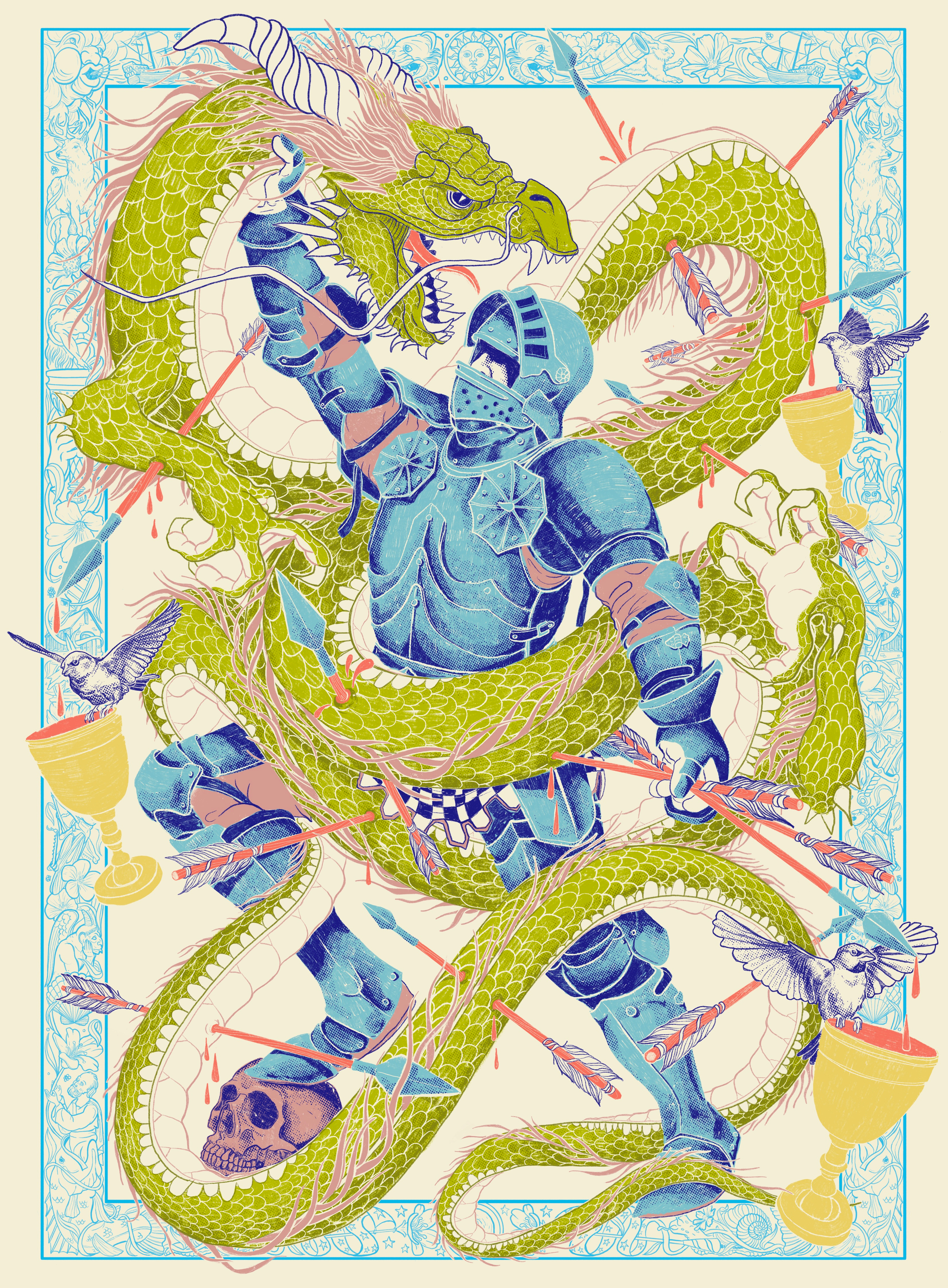
Scott Aasman: Yeah, this one is called Blood of Dragons//Language of Birds. It’s loosely based off of the story of Sigurd and the Dragon from Norse mythology. There’s an old, old story that goes, that if you drink the blood of a dragon, you can understand the language of birds. That was the starting point of the entire image. It’s a Norse story, but it’s obviously not Norse imagery. I’ve got a European knight there. It’s very loosely tied.
If we want to rewind a little bit here, the way I approach these images, I’m dealing with different versions of narrative. The meta-narratives that go beyond culture, that form who we are as people groups. Whether they are religious stories, myths, or cultural stories, I like to infuse some personal narrative into these as well. Also local narrative, so my community, my city, or my country. There’s always a layering of narrative in these as well, so hopefully people can relate them on different levels.
So this dragon one. I was really interested in the story of Sigurd, and the birds that helped him defeat this dragon. I also thought it was really interesting, this idea of drinking blood. It’s a part of our sacraments as a Christian.
I’ve been thinking a lot about dragons the past couple of years. They’ve been really interesting to me. In a lot of cultures, they are not purely evil. They can be helpful and beautiful. Even in the Bible, as I just mentioned, Moses is told to raise a bronze snake that the Israelites were to look to for salvation from disease. The term “seraph” in Hebrew can be translated as “fiery serpents”—so is it too much a stretch to think of God’s angels being dragonlike?
Maybe I don’t want to go too deep into this, but I did have a sort of weird spiritual encounter with Jesus where he kind of revealed himself in the shape of a dragon. It was a weird experience, but it also provided a sort of impetus for this image. There’s this idea of someone wrestling with a dragon, which also points back to Jacob wrestling with God.
Traces: I did pick up on the design for the dragon being drawn from the Asian Lung Dragon, rather than the more European Wyrms. And the Asian dragon motif tends to be associated with blessing and benevolence. It’s easy to make a connection here with St. George and the Dragon, but the pose and framing mimics more the images of Jacob wrestling the angel.
Scott Aasman: That was a very conscious effort. Taking the Asian style dragon, sort of long and twisty—one that was held up, rather than pinned down. I think a lot of it is exploring my relationship to European myth and a North American.
Both sets of my grandparents immigrated from the Netherlands. So I do have a bit of a tie to Europe in my blood, but I’m trying to figure out what it means to be a North American and understanding these stories. How can I bring in more stories of this land? I know Martin Shaw has talked about knowing the stories of the places you’re from. And you and I were at Breath and Clay, and I was talking to Malcolm [Guite] about it as well. He gave me some insight to, that there’s such a rich tradition of storytelling here in North America as well, and Jesus shows up in those places, too. So how do I tie into those?
I’m losing this particular piece in it, but this is tying into the broader or bigger issues I’m running into with telling stories in my art. Deciding what stories to tell. I guess with this one, it’s a Nordic story that I’ve put a more western European spin on, with elements of what I learned from Asian cultures and their views of dragons, plus my personal story of experiencing Jesus as a dragon are all colliding in this thing. What happens when we drink Jesus’s blood? What happens then? We speak the language of birds. We engage with nature differently. We engage with the world differently.
Traces: I would like to move into the St. Christopher image. As we were selecting illustrations to discuss, you mentioned this one was a little bit more of a struggle or a wrestling to bring it into being. It took you a number of years.
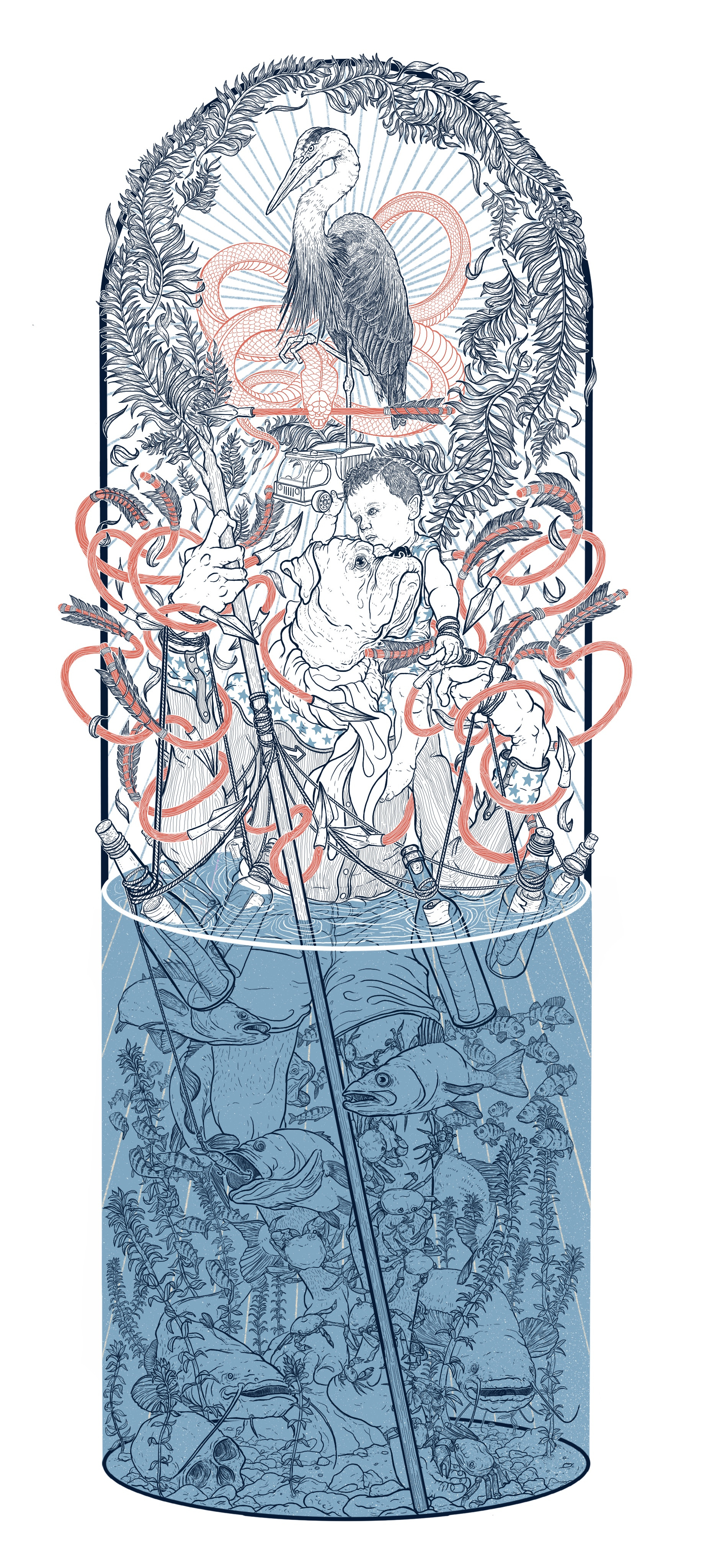
Scott Aasman: This image is another one that is really important to me. It’s from a series called “Lullubies, Legends, and Lies.” where I made a conscious effort to put a number of stories from the Bible, to Christian and classical myth in a narrative blender both as an image but as a story and see what happens. This story, this image I made, I started almost ten years ago. I drew out a good portion of the upper half in pen and ink. My son, who I modeled into Jesus in this image, drew on it with a marker. I was kind of defeated and let it sit for a number of years, before I pulled it out, digitized it, and kept working.
It deals with the story of St. Christopher. In a lot of Orthodox icons, he’s depicted with a dog’s head. This sort of ugly, terrifying creature from the fringes. His entire life, he was seeking the most powerful one to serve. He goes to a warlord, who cowered at the feet of a king, who cowered at the feet of Satan, who cowered at the symbol of the Cross, but he couldn’t find Christ. So he gave up on following anybody. He began a life of just helping ferry people across a river. Eventually, a child came to him who needed help crossing the river. As he carried this child, he realized how heavy the child was getting and almost drowned. When he reached the other side and dropped the child off, the boy revealed himself as Christ. He said “While you were carrying me, I was carrying the entire world.” From there, he follows Christ until he is martyred, getting shot by arrows. Although several of the arrows that were shot missed him. There’s a lot of cool mythology around that.
This story comes from the Golden Legend, a book of popularized lives of the saints. And that’s what this piece was based on.
I used my son carrying his favorite truck as Christ , and I had a whole bunch of local freshwater fish swimming around him. Fish from the area where I’m from. I was kind of tying in his early life, the dangers around him. Him crying out, looking for someone to serve amidst the tumult. Christ revealing himself.
It’s working in several layers. It has the river scene itself, elements of his death, elements of his search, and the tension between all of that that he must have felt.
Traces: Out of curiosity, you have these arrows which are in a kind of scribbly pattern. Is that a reference to the original destroyed image with marker scribbles?
Scott Aasman: You know it could be, although it was unconsciously done. It would kind of fit with the story and the making of the image. That’s all where the scribbles were, too. That’s a good observation.
This one is an older image. I feel like I’ve changed a lot as an artist since doing this one. But it was one of the first real deep dives to see how far I can push this storytelling in an individual image.
Traces: Another one that you had sent was the Aspidochelone.
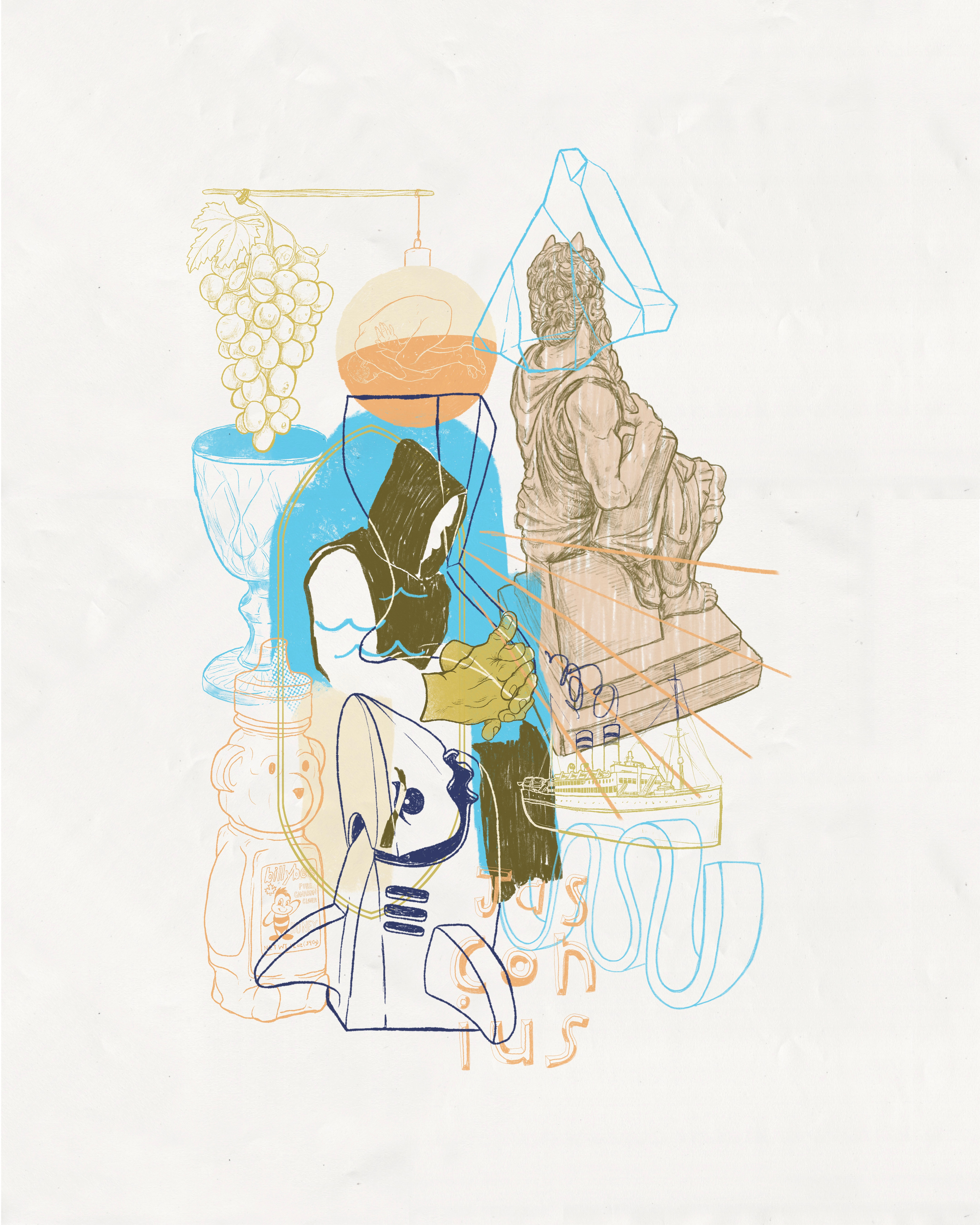
Scott Aasman: This one is based on a couple of different stories about navigation, and my grandparents’ journeys to North America from Europe. It’s about St. Brendan the voyager. The land of milk and honey. The Promised Land.
In 2019, my last surviving grandparent passed away. We’re going on seven years ago that this happened, but I’d been thinking a lot about legacy and the journey that my grandparents took, this act of faith after World War II when their country was demolished. They were young. They got married and moved across the ocean to a place where they could only take one suitcase and not a lot of money. At the same time I was reading about St. Brendan and his journey. In it, there’s the aspidochelone. It’s depicted like a colossal whale or turtle, and it resembles an island. It’s often luring sailors to their death.
There’s this interesting story of St. Brendan, and he sees this island in the middle of the Atlantic. They celebrate Easter on it. It ends up being a whale, named Jasconius. He celebrates Easter on the back of the whale, who complains about their fire causing pain and kicks them off, and they continue on. I was thinking of St. Brendan sailing to a new land, but also North America being Turtle Island, and the land of milk and honey for my grandparents—but also how are we perhaps ‘making a fire’ where it does harm to the place we are—and how can we better honour the place we find ourselves.
The little ship on there is the ship that my grandparents immigrated on, as well as a set of my wife’s grandparents. Two years ago, we visited Halifax, Nova Scotia, where they have the actual port where the ship landed and my grandparents entered Canada. The gates that they walked through. At that time, I was thinking a lot about what it means to enter the desert or wasteland in order to come to a new place. What it means for that place to have its own identity and being, and how do we adopt the place, and yet let it be its own place with its own people and stories and character and personality. How do I navigate my European roots with my Canadian identity now? It’s a collision of different stories and cultures coming together.
Traces: I want to go ahead and move into your work with comics, as I know that this has been a new move and taking up a lot of your time recently.
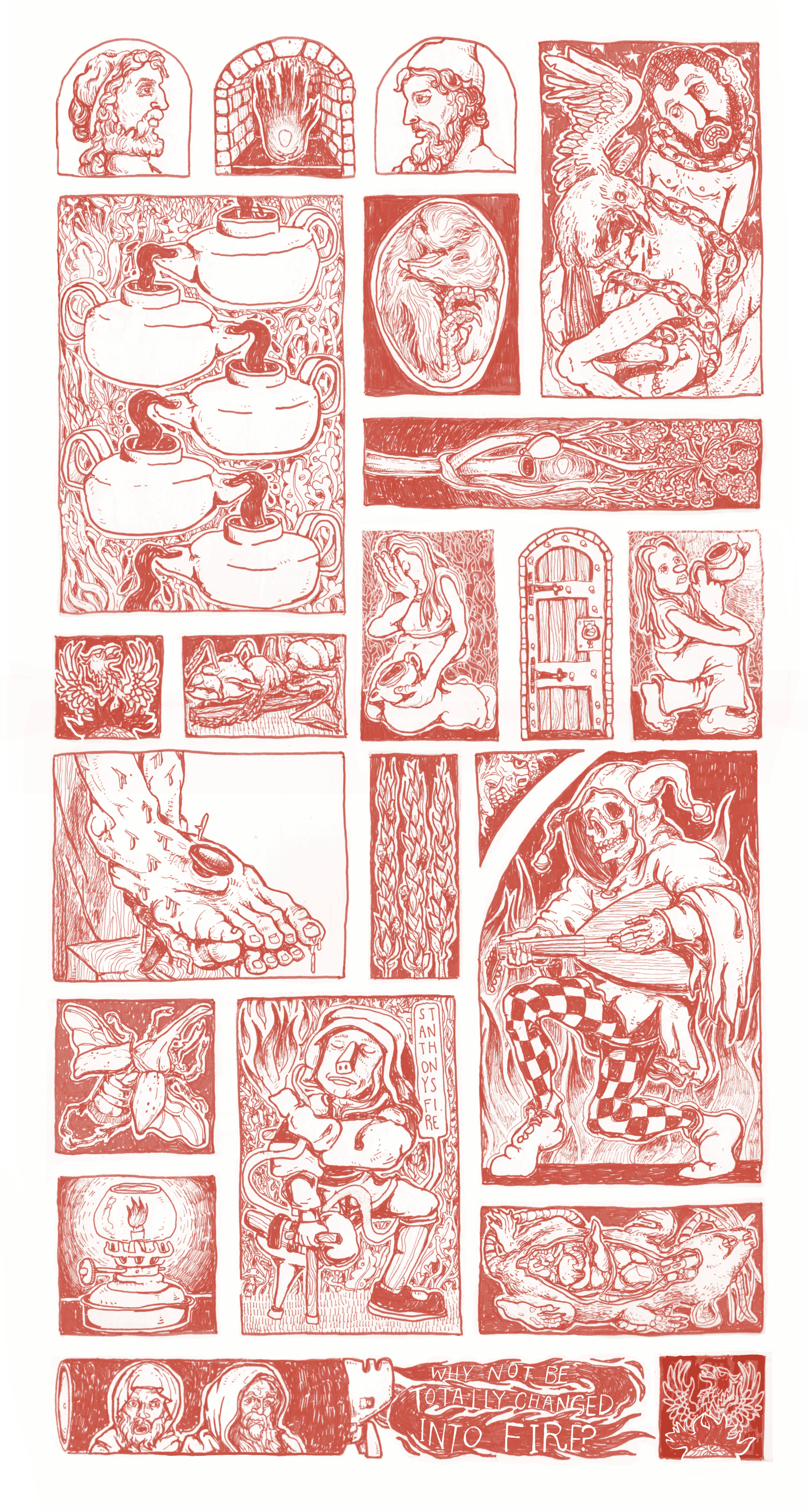
Scott Aasman: As My kids started reading, they gravitated towards comics and graphic novels, and I started reading with them. I was blown away by the stories and art that was present in many of them. It wasn’t very acceptable literature when I was their age, but it’s a legitimate artform! As an adult coming back to Charles Shultz and Bill Watterson now, there’s some deeply profound and beautiful stuff in there! But there is also just a lot of good storytelling.
But my introduction to comics started with a zine that our friend Corey [Frey] and I have been working on for a couple of years called nephew. We’ll talk about a weird idea. I’ll draw a bunch of pictures, and Corey will write a bunch of words that turn into a poem, and we’ll sort of smash them together to see what happens. The marrying of image and word is at the heart of illustration and at the heart of comics.
I’ve always sort of had my images layered on top of each other but this caused me to stretch things out a bit and make space for words. Eventually, I just took the plunge and created boxes to go to a more traditional comic look
I have a series that I’m working on called Men Like Trees Walking. I’m almost done with all of the drawing, and then I’ll do a bit of digital editing. It’s trying to stretch how far images can go in storytelling and how the brain fills the space between two loosely tied images. It’s not a very straightforward way of comic book making, although I have been exploring more traditional comic book making with the Dolorous Stroke which is going to be published later this spring, as well as another one based on The Wasteland from T.S. Eliot.
I’m interested in how the brain connects different panels when there are no words. But I also wanted to create something a little more approachable.
I’ve shown a lot in group shows and galleries. That’s exciting to me still, but it felt like trying to cater to an intellectual crowd. Maybe like you’re trying to play games or reach a certain level of credentials. I like comics because there is an un-pretentiousness to it. There’s a really cool community for it in my city, of people who just make stuff. There’s something very low stakes and democratic, but also the potential to say something very deep. I really like how it can just be xeroxed and stapled together and handed out. It doesn’t have to prove anything. It just is what it is, a thing that can exist.
Traces: Seeing some of the posts and comics that you have shared, they have a very Folk Art kind of feel to them.
Scott Aasman: I think you can see thats an overall trend I’ve been working at in my all work. In my older work, like the St. Christopher, I was very purposeful and tight about where I placed my lines and how I formed my work, and I’ve been trying to loosen that up. For the longest time I was pushing for accuracy and perfection, but with the digital tools so prevalent and accessible nowadays, I’ve grown a bit tired of perfection, and I just want to see the hand present in the work again. Making comics feel like I have permission to remain loose. It more naturally aligns with my sketchbooks and how I love to draw. I mean, I still like doing my fine art work, and am more than happy to provide clients with a cleaner style. There’s nothing wrong with purposeful design, composition and intention. But what I love about comics is they seem more akin to discovery and play.
I feel like there’s a lot that connects with comics that feel more natural and how I want to make work, rather than how I ought to make work or what would please a client. It’s more punk rock. For me, it’s getting to the fun of artmaking that can get lost when you’re too focused on the expectations of meeting deadlines, client work, “career building” and trying to make a name for myself.
Traces: That reminds me of an article that I read from Ted Gioia that discussed our lack of folk music. Not as in Indie Folk as a genre, but folk just playing music in their living rooms. He opines that in childhood, you should encourage just playing music, as in playing with instruments, goofing off, playing badly, and doing it for fun as a good and excellent thing to do. Skill and discipline can come later.
Scott Aasman: That’s a thing I’ve come back to with my students in the classes I teach and in my workshops, like Drawing Goodly Badly and Tending the Garden of Ignorance. It’s important to have things like a sketchbook where you don’t feel like you have to perform as an artist. Instagram and social media have commodified our hobbies and tried to turn them into side hustles instead of things that are just fun or are just good and right to do. So I encourage my students to be able to just step back and draw through exercises that ask to draw with their left hand or with their eyes closed, and in doing so focuses them on process over product, and find that mark making can be surprising and supremely satisfying. Having the freedom to do something poorly is a lost art for our kids and our communities.
Traces: Thank God for folks like you who are finding ways to reach an audience who aren’t looking for words or poetry. But you can catch the eyes looking at more modern art and get a good dose of mythology while their there!
Scott Aasman: That’s the goal!
Liv Ross is a poet and essayist writing in and from the Ozarks. In addition to writing, Liv practices gardening, pipe-smoking, leather-working, music-making, and mischief. She has been published in The New Verse Review, The Front Porch Republic, Silence and Starsong, Solum Journal, and VoeglinView. She also serves as Managing Editor for Traces Journal. Her first book, The Blackbird Ballad, is scheduled for publishing May 2026 from Solum Literary Press. She can also be found on Instagram @liv_ross_poetry, or her substack, https://substack.com/@theabbeyofcuriosity.