


“What, would you know thy lord’s meaning in this thing? Know it well, love was his meaning. Who showed it to you? Love. What did he show you? Love. Why did he show it to you? For love.”
“And then saw I that all the compassion that man has on his even-Christian with charity, it is Christ in him, that all the noughting that he showed in his passion, it was shown again in this compassion … and that his pains and his tribulation surpass so far all that we might suffer, that it cannot be fully thought.”
Julian of Norwich (c.1342–after 1416) lived at the same time as Chaucer. She was an anchoress, a mystic who came to live in a small cell attached to the south side of St Julian’s church, from which she took her name. Established in the cell at least by 1394, she wrote in A Revelation of Divine Love about a series of sixteen mystical “showings” that began with a vision of a cross held before her by a priest on 3 May 1373 as she lay near death.
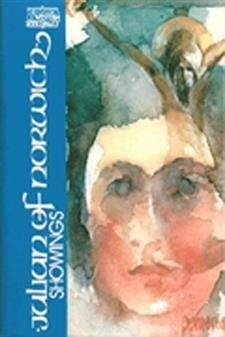
The first quotation above comes from the closing chapter, chapter 86, of A Revelation of Divine Love. Julian’s unadorned and penetrating question, “What, would you know thy lord’s meaning in this thing?” affirms the human search for meaning. She anticipates a lingering difficulty for her reader, a querulousness, an embarrassment, a refusal to acknowledge curiosity maybe, a genuine puzzlement. “This thing,” the Lord’s passion, is overwhelming. Perhaps it seems vaguely inappropriate, even gauche, to seek to know its meaning, as if doing so were to limit the passion or commodify it in some way, a little like asking, “Will this be on the final exam?”
Julian pushes past all of this with a simple invitation. She meets us where we are and encourages us to hope that an eminently reasonable and natural question, “What does it mean?” might possibly be met with an answer we can believe in.
She then puts us at ease: “Know it well.” This is an affirmation. There is indeed something to be known and understood, something that can satisfy our deepest intellectual cravings. Maybe the idea of finding meaning seems somehow sterile or one-dimensional. In an Age of Reason or an era of technocratic modernity, many people look to rational explanations to suppress a certain kind of aspiration and vitality. Yet Julian invites us to lean into our desire to know and to find meaning.
To admit even now, finally, to a hunger to know opens up something interior. The simplicity of the response matches that of the question she has posed: “love was his meaning.” This answer meets us before it wrongfoots us. Divine love as expressed in cataclysmic suffering fulfils whatever demands one might have for meaning. The Passion provides intellectual satisfactions, if one is prepared to let it.
At the same time, what Julian says defies expectations. Coming at the end of an entire book elaborating a vision of the cross, “love was his meaning” activates a paradox. It takes the addressee beyond their capacity to make sense of “the thing” – suffering, the Passion, how an all-powerful God could organize the redemption of a world he created around the sacrifice of his own self – in terms of a satisfied curiosity. We discover that “meaning” has more dimensions than anything we can think or imagine. Christ’s suffering and death, his “noughting,” cannot be fully thought.
The idea of finding meaning in its turn unlocks dimensions of love. Love is more than a feeling. It’s certainly more than sentimentality. Love lives in the reality of Christ’s life and passion; it encompasses questions of identity, substance, and purpose, who, what, why. The vision of the love to which Julian points her readers is clouded over by all our efforts to express or represent its fullness.
Yet this limitation does not cripple us by leaving us within an intellectual puzzle. Rather, Julian affirms all our acts of compassion in the recognition that they are participations in Christ’s love. They too are grounded in the same paradox. We have been drawn into this life, a life of love beyond our capacity to fathom it.