


The Wren by A.F. Moritz (House of Anansi Press, 2026)
Reviewed by Liv Ross
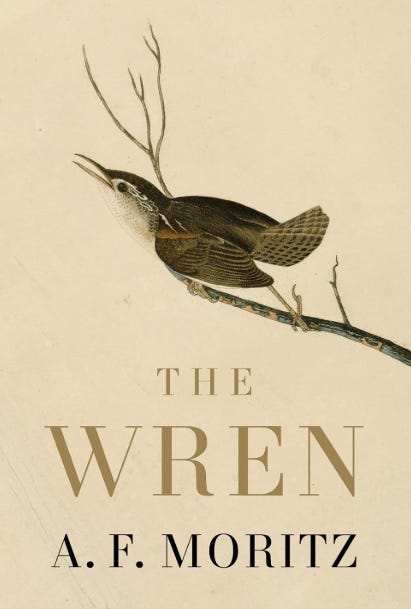
The Wren, A.F. Moritz’s latest collection from House of Anansi Press, is a challenging book of poetry, ready to reward the attentive reader. Attentiveness is a key characteristic for fully appreciating Mortiz’s The Wren, as reading this collection is very similar to birdwatching.
With patience and focus, the reader will uncover poems filled with epiphany and light, but these moments are fleeting, and, like the wren fluttering from branch to branch, what was previously grasped can be quickly and momentarily lost again.
This feeling is captured in the title poem, appearing in the last quarter of the book. In the poem, the narrator is watching a stand of young trees until he notices movement:
			From deep inside,
the smallest wren hops near, just to its edge,
and jerks and flutters, peering out, being glimpsed,
withdrawing again—into the thick of the doll forest
to be guessed there, its existence, the sighting of it
doubted, a legend of memories and hints.
This sense of watching, waiting, glimpsing, and losing cycles throughout the collection. At times, i can be a little bit disorienting. There is no obvious narrative throughline. No clearly felt rhythm. There isn’t even a table of contents to use as a roadmap. There is just a series of memories and hints to follow from page to page.
But while the poem “The Wren” captures the feeling of frustration and at-a-loss-ness of the collection, it also contains the key. The word “legend” in the final line could refer to doubt that precedes it, I suppose. One definition of the word is, after all, an unverifiable story. But “legend” can also mean the explanatory list of signs or symbols. There are memories and hints left behind by the sighting. Just so, there is an index of the poems, complete with their page numbers, after turning the page on the final poem.
Memories and hints—retrospection—are an important aspect of moving forward, of finding the bird again, but they do not bring ease or automatic success. Moritz does not pretend that they do. He, at times, seems to be just as stymied as the reader by this cycle of discovery and hiddenness. He states it in one of my favourite poems, “Attempted Retrospect”:
I’ve done the best I could
*
No, that’s not right either.
Two spare lines. The poem seems fatalistic, and it might have been if it had closed out the collection. As a final line, it seems like giving up, but since it comes only halfway through, there is a sense of picking up the pen and trying again. There is a back-and-forth with memory, trying to understand the past in order to navigate the future.
Hints and memories are borrowed from other writers, poets, and historical figures throughout this collection as well. The opening poem “Tieger, Tieger” looks to Blake’s “The Tyger.” “Henri Bergson” contemplates experience and understanding. Apollo retells the contest of Apollo and Marsyas. These reflections and callbacks interweave with the poet’s own questions and observations. They don’t quite form a roadmap, but they have a solidity to them, an importance. I am reminded of T.S. Eliot’s line, “These fragments I have shored against my ruins.” Some of the poems feel like fragments of a larger vision of the world. Take “Talking with Stones”:
every stone is a
head a
grave
stone
erased
heavy quiet
fall on your
knees bend bring
your face close to the
dirt kiss taste
what
things
are beneath
these lips
have
for the time
being
no words
The feeling and form of this poem is fragmented. It employs sudden and frequent enjambment. The picture it builds is incomplete. Something feels missing, but in the way that something feels missing from a ruin or a weathered memory. Despite the fragmented or out-of-grasp nature of the poem, Moritz bridges the form and content of his work and the world around him by mirroring the fragmented nature of reality in his work. The poem captures the feeling of sitting with an old and fading gravestone or a tumbled-down wall. The thing itself is incomplete, but there is much – even more, perhaps – to contemplate about it nonetheless.
Everything fades or falls to ruin. People die, castles fall, stories end, but there is always a new story beginning somewhere else. Someone will always be there to talk with the stones left in ruin. This might be especially the job of artists and poets – to enter into conversation with the ruins of our world –but this is no easy or simple task.
Poets and artists figure throughout the collection as speakers or subjects of Moritz’s poems. In “The Guitar,” a figure in the poem flees up a mountain to reach a cabin and escape from a burning city in its last days of war. He intends to play the guitar once he reaches the safety and quiet of the cabin, but finds that all he can do is sit and stare for a while. The guitar is ready to be played, but there must be time for silence first.
There is a lot of space and silence in The Wren. Most of the poems are very short. There is a lot of white space between them, and they demand that a reader take time with them. Pause and contemplate. Revisit and reimagine. Like the careful birdwatcher strolling through the woods, open to what he might see, these poems and fragments offer pieces and glimpses of a larger vision of reality. The pieces might be fragmented at times or difficult to enter, but sometimes the valuable treasures are the ones that require a bit of a fight.
Liv Ross is an urban monk, a poet, and essayist writing in and from the Ozarks. In addition to writing, Liv practices gardening, pipe-smoking, leather-working, music-making, and mischief. She has been published in The New Verse Review, The Front Porch Republic, Silence and Starsong, Solum Journal, and VoeglinView. She also serves as Managing Editor for Traces Journal. Her first book, The Blackbird Ballad, is scheduled for publishing May 2026 from Solum Literary Press. She can also be found on Instagram @liv_ross_poetry, or her substack, https://substack.com/@theabbeyofcuriosity.
A. F. Moritz has written more than twenty books of poetry, most recently, Great Silent Ballad (2024), As Far As You Know (2020), and The Sparrow (2018). Moritz served as the sixth Poet Laureate of Toronto from March 2019 to May 2023. He also served for more than a decade as the Goldring Professor of the Arts and Society at Victoria University at the University of Toronto. Moritz has received the Guggenheim Fellowship, inclusion in the Princeton Series of Contemporary Poets, the Award in Literature of the American Academy and Institute of Arts and Letters, and the Ingram Merrill Fellowship. He is a three-time nominee for the Governor General’s Award for English-language poetry (Rest on the Flight into Egypt, The Sentinel, and The New Measures). He was the winner of the ReLit Award for poetry in 2005 for Night Street Repairs. His collection, The Sentinel, a Globe and Mail Top 100 of the Year, won the 2009 Griffin Poetry Prize. And Great Silent Ballad received the 2025 Al & Eurithe Purdy Poetry Prize.