

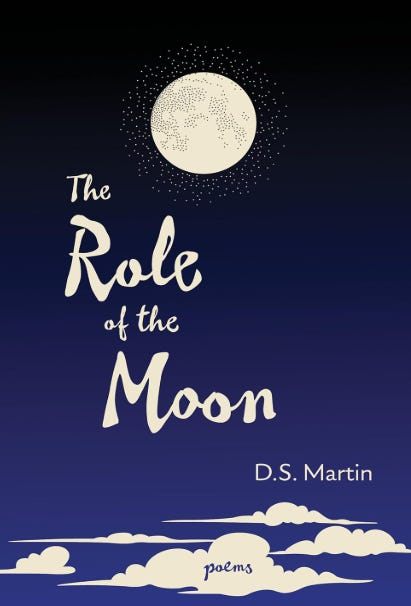
The Role of the Moon by D.S. Martin (Paraclete Press, 2025)
Reviewed by Vilma Blenman
Walking in Moonlight
On a warm night last fall, my husband and I went for a late, before-bed walk. I was startled by a light shining on the sidewalk—a light so bright I could count the cracks in the concrete and trace the brownish outlines of the maple leaves which had fallen and left their imprints. Street art created by rain and sun.
This memorable light did not come from the suburban streetlights. The source was the moon—a full luminous, October orb watching us as we walked that night.
The poems in D.S. Martin’s new collection, The Role of the Moon, remind me of that moonlit walk. They shine. They make one look up at the Moonmaker’s artistry, then down at one’s feet, the feet that sometimes misstep and sometimes place themselves perfectly in mindful motion.
The author himself categorizes the poems as “metaphysical” poems. In his introductory note to readers, D.S. Martin states his take on the genre saying, “…Metaphysical Poets to me simply mean those who use metaphors—sometimes elaborate, extensive metaphors to talk about ideas outside of human sense perception.”
There are nineteen poems identified as Metaphysicals in this collection, based on John Donne’s Holy Sonnets, which have long held deep significance to Martin. But do not let the word “metaphysical” frighten you. These poems are as fresh as dew and as accessible as the closest carwash. Though the form is ancient, Martin creates a central image in each that bridges form and content, making the poems as modern as machines with nanochips, and as relatable as the couple fighting in an IKEA showroom. In addition to choosing subject matters which resonate with today’s readers, the poet manages to create a reflective mood in the poems, reminiscent of one pausing to ponder and look at the moon’s image mirrored in a still pond.
Slowly and seamlessly, the reader is moved from the mundane to the transcendent. Take, for instance, the poem, “Water Tower” (Metaphysicals III), which ends with a cry for rain to sustain a town’s water supply. The poem begins in a familiar place, “In the heat of summer as afternoon /wears on…” but past line two, there is a short yet intense journey which will require one to reflect on the merits and meanings of one’s aspirations or actions over the years.
So much of what I’ve been given
slips through my fingers   evaporates
into open air  	goes down the drain
So much sweat   so many tears
over lesser desires I’ve aspired to
have weighed my prayers for years
By the last line of the final stanza, which flows from these two reflective thoughts, the water tower is left behind, and one has transcended earth to another place, taking thoughts of life after this life.
Similarly, the poem, “Sparrow” (Metaphysical XII) ostensibly centres one in the drama of the persona rescuing a bird “caught & fluttering in the/ mechanism of the feeder’s perch,” but transcends its subject. The poem begins innocently with an observation that “backyard birds… call us to praise.” Later, in the description of the sparrow’s response to being freed, the reader is transported to thoughts about freedom and destiny, thoughts rising higher than the tree in which the sparrow ultimately lands safely, doing “as she is called to do.” At the end of this final phrase of the poem, one cannot help but ask the questions: What am I called to do? What is my role?
In astrological terms, of course, the major role of the moon is to reflect the sun’s light at night and thus become a night guide. We experienced that guiding the night my husband and I walked, holding hands, and smoothing differences we’d held before setting out. In the title poem, “The Role of the Moon,” (Metaphysical IX), D.S. Martin affirms this hopeful, redemptive role and Presence of the moon. Here the persona imagines himself to be in a stage play where he plays the role of a stone and God plays the role of the moon. The opening stanza sets the stage:
I play the part of an earthbound
stone   you  the role of the moon
in this silent   ceaseless  standoff
The tension in this stage play is rooted in the stone’s discontent with its lot, its essence or position relative to the moon. There is a questioning of roles. Would he be better off, or be noticed more, or drawn closer to the moon if he were not what he is, an “oversized pebble,” but rather a “monument,” or a “mountain,” or a “craggy coast?” What if he had a role more majestic, more noteworthy? In the end he concludes that the moon’s distance is “just a pose mine/ a fallacy and it’s a “mercy/ that you feign to turn away.” The stone’s lament gives way to recognition that he could not bear to be laid bare, to be given the spotlight at all times, hence the gratitude for mercy. Similarly, in John Donne’s sonnet that provides a writing prompt for this poem (Sonnet IX), the persona progresses from lamenting to lauding his Benefactor whose nature it is to forgive. The final line of the sonnet states: “I think it mercy if Thou wilt forget.” Here again is the movement from confusion to revelation. Light shines.
I remind myself that the book’s title is not “The Light of the Moon” but The Role of the Moon. So what is the role of the moon? Not primarily the science of the moon. It is essentially the stage role, the part in the play that the stone does not have. If I read the poems well, I think it is the role of the Director, the one who decides on the parts and how the parts are to be played. The moon has the most oversight, the brightest light and is the most benevolent. Thinking of the moon this way reminded me of the old English nursery rhyme:
I see the moon and the moon sees me.
God bless the moon and God bless me.
It is an image in which the moon bestows blessings and beauty mirroring what it is given and giving those gifts to me. Ultimately, its role is redemptive.
Perhaps this redemptive role is why the poems in D.S. Martin’s latest collection emanate such hope, even the poems which deal with themes of rust and ruin. There is hope for the ruined garden and the careless gardener portrayed in the opening poem, “Garden,” (Metaphysical I). The gardener “mourns” and confesses that though “well meaning,” there have been grave mistakes:
misguided   having let children run amuck
Through border beds   They’ve torn
iris leaves for wispy swords   trampled stems
& muddied blooms beneath their rubber soles
There is no denying devastation. Clearly, things have gone awry and “it’s all needing repair.” However, the last stanza affirms the role of the original gardener who will repair the ruined garden and comfort the despairing gardener.
You’ve made me & this garden & will your work
decay? I’m a dried-out vegetable patch overrun
with weeds an olive orchard filled with tears
I look to you	to conquer all my fears
Here, the reader looks up from the page and joins the gardener in this hopeful stance.
As one continues to contemplate the moon’s role, one thinks, by extension, of the moon’s varied shades and shapes—crescent, half-moon, or full moon. Her light shows up differently in different quarters. Likewise, variety is built into this collection. The poems are not all “full moon”- themed. “Kitty Stobling Dances On,” for example, is enchanting and thought-provoking in its opening lines that question why a stilt-walker would walk “precariously on a downtown street” then call out to gawkers to come and dance with her. But one has to wait and imagine the moon is still there, hiding behind a cloud.
The rogues of the world   mock all that’s beyond them
I’m mainly an observer  not smooth on my feet
but I dance in midair    where beauty walks    waiting
& the love of God stirs like wind in the wheat.
Suddenly, in that last stanza and last line in particular, light bursts into view and shines on the central argument—one may be uncertain about many things; the rationalists may demur, but there are certainties that remain—beauty and the love of God. Similarly, the poem, “The Change,” takes us on a journey towards light, showing it like a crescent moon. This poem tells the story of a trip to the Dominican Republic to offer practical help in rebuilding a house after its destruction by mudslides and rainstorms. I love the way the persona first observes the ravages of nature, the impact of the “break & enter” of a rushing river and then shows light emerging in the rebuilding through community action and love of neighbour and laughter, including his wife’s. Light and life accompany each poem.
That light is also reflected in the way D.S. Martin brings old poets and poems into new limelight. For example, in “Miles to Go” – a riff on Frost’s snow-filled poem, a poem about a known poem, there is a fresh, creative take on the role of the horse and the meaning of the shaking of the harness bells:
… his little horse stops
not because he’s pulled her reins     but because
of nothing    his usual encouragement    absent
& she senses his need    to sweep
aside his grief.
Suddenly, the reader sees the poem’s persona differently, and pathos rises up for the man who “weeps over promises he’s unable to keep.” It is a surprising twist on a familiar ending and brings new appreciation for an old poem.
“The Role of the Moon” is a new volume to keep handy on one’s bookshelf. For all its luminous lines, for all its diverse themes, for its easy access into the hallowed halls of metaphysical poetry, I love this collection. I believe that you will love it likewise. It has garnered high praise from people like Rowan Williams, former Archbishop of Canterbury and Sydney Lea, former Poet Laureate of Vermont. But it is a book for everyone and for every season. As winter retreats and spring returns, I recall the light-guided walk on that warm autumn night and promise myself to do it again–go walking in the moonlight.
Vilma Blenman is a Caribbean Canadian poet, a mother of two, a retired teacher and therapist. A member of The League of Canadian Poets, she is published in their online journal, “Poetry Pause”, in the Canadian bestseller “Hot Apple Cider” series, in Faith Today and in Ekstasis (now Inkwell). Vilma writes primarily on themes of memory, identity, and the healing beauty of landscapes. In 2025, she published her debut poetry collection, “Brown Eyes Watching: Reflections of a Black Canadian Poet.” She is a mentee in the Diaspora Dialogues program and is currently working on a memoir in verse. Vilma and her husband, Grantley, live in Pickering, Ontario.
D.S. Martin is a Canadian poet, Series Editor for the Poiema Poetry Series, and Poet-in-Residence at McMaster Divinity College in Hamilton, Ontario. His previous books of poetry include: Angelicus (2021), Ampersand (2018), Conspiracy of Light: Poems Inspired by the Legacy of C.S. Lewis (2013), Poiema (2008), and the chapbook So The Moon Would Not Be Swallowed (2007, Rubicon Press). His poetry has appeared in many publications around the world, such as Canadian Literature, Christian Century, Dalhousie Review, Event, Irish Times, Practical Theology and Queen’s Quarterly. He and his wife, Gloria, live in Brampton, Ontario. They have two adult sons.