

Book Review: "Reading the Bible on Turtle Island: An Invitation to North American Indigenous Interpretation" by H. Daniel Zacharias and T. Christopher Hoklotubbe
Reviewed by Jeffrey-Michael Kane
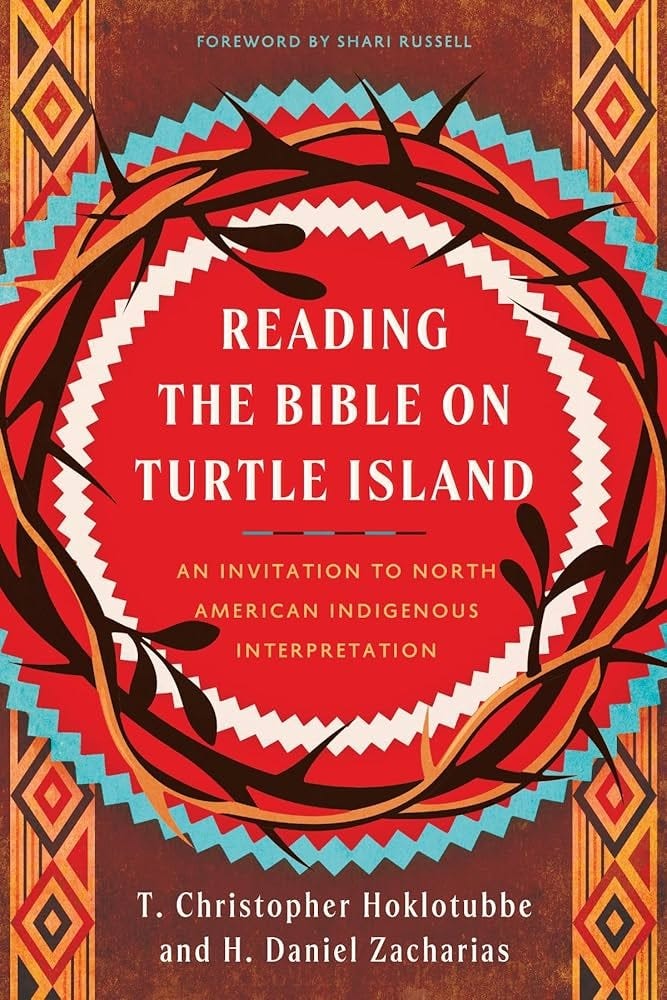
Reading the Bible on Turtle Island: An Invitation to North American Indigenous Interpretation by H. Daniel Zacharias and T. Christopher Hoklotubbe (InterVarsity Press Academic, 2025)
Reviewed by Jeffrey-Michael Kane
The Land Is the Ledger
Reading the Bible on Turtle Island does not ask whether Indigenous perspectives belong in biblical interpretation. It asks whether the Bible, as received by the Canadian church, has ever been properly placed—set down on this particular land, read in the presence of the peoples who were already here, held accountable to the covenants that were broken in its name.
H. Daniel Zacharias and T. Christopher Hoklotubbe bring specific credentials to this question. Zacharias is Cree-Anishinaabe/Métis, raised in Winnipeg on Treaty One territory, now Associate Dean at Acadia Divinity College in Nova Scotia. Hoklotubbe is a citizen of the Choctaw Nation, a professor at Cornell College in Iowa. Both are faculty for NAIITS, the first accredited Indigenous-designed theological institute in North America. They are not outsiders proposing a thought experiment. They are insiders proposing a return.
The book’s methodology is what the authors call “Turtle Island hermeneutics”—a reading practice rooted in Indigenous ways of knowing. They structure the work around the metaphor of the Big Drum, which calls people together for ceremony, and the Circle Dance, which moves communally rather than linearly. In interviews, they describe their collaborative writing process as “theological jazz”: passing prose back and forth, improvising on biblical themes, allowing insights to emerge from encounter rather than extraction. The approach is deliberately non-systematic. It resists the tidy categories of Western biblical scholarship in favour of something more relational, more rooted in story and place.
This could easily become sentimental. It does not. The book’s strongest moves are technical, not atmospheric.
Consider their re-translation of Genesis 2:15. The traditional English rendering—God placed Adam in the garden “to till it and keep it” (RSV/NRSV)—positions the human as manager, overseer, agricultural executive. Zacharias and Hoklotubbe argue that the Hebrew is better rendered “to serve and conform oneself to” the land. The shift is small but seismic: the human is no longer master of the garden but its humble kin, shaped by the place rather than shaping it. This is not mere interpretive license. It is a defensible reading of the Hebrew, one that simply sounds different when heard on Turtle Island, where “dominion” has meant something very specific and very violent.
The authors build a series of such reframings, each placing a biblical text alongside an Indigenous experience and asking what resonance emerges.
Jesus’ forty days in the wilderness become a Vision Quest—a ceremonial practice of fasting, solitude, and openness to spiritual direction that is native to many North American peoples. The Holy Spirit descending as a dove becomes, in their reading, an “enfeathered” God, continuous with Indigenous understanding of birds as spiritual messengers. This is not syncretism in the pejorative sense. It is a claim about continuity—the recognition that the Spirit was present on this continent before any missionary arrived, and that the forms of that presence might look like what Indigenous peoples have always known.
The most striking parallel is also the most uncomfortable. The authors read the story of Naboth’s vineyard—in which King Ahab, with Jezebel’s help, arranges the judicial murder of a man who refuses to sell his ancestral land—through the lens of the Doctrine of Discovery and the broken treaties that followed. Naboth’s crime was refusing to treat land as a commodity. His punishment was death and dispossession. The application to Canadian history is not subtle, and the authors do not make it subtle. They name the Numbered Treaties. They name the legal architecture that permitted the seizure of Indigenous land in the name of Christian civilization. They ask whether the church that carried the Bible to Turtle Island has ever reckoned with the fact that it also carried King Ahab’s logic.
Similarly, the Babylonian Exile becomes a lens for understanding the Residential School system. Both involve forced removal from ancestral land. Both involve the deliberate suppression of language, ceremony, and memory. Both produce a literature of lament and survival. The parallel is not exact—no parallel ever is—but it is productive. It asks the Canadian reader to consider what it means that the Bible contains its own archive of displacement and forced assimilation, and whether that archive has ever been read honestly in a country that produced the Truth and Reconciliation Commission.
Not every move in the book lands with equal force. The reading of the Atonement alongside the Sun Dance ceremony and the story of Corn Mother—both involving sacrificial suffering for the sustenance of the community—is suggestive but insufficiently argued. The book gestures toward equivalence without establishing its terms, leaving the reader to supply a theological bridge that the authors do not fully construct. The structural resemblance is real — all three narratives turn on suffering that sustains — but the authors do not pause to ask whether the mechanics of sacrifice are commensurable: whether the once-for-all logic of Pauline atonement and the cyclical, communal logic of the Sun Dance and Corn Mother can bear comparison without flattening each other. This is precisely the move most likely to alarm the book’s evangelical readership, and it is the one place where the authors offer neither the theological scaffolding to follow nor the exegetical argument to refuse. This is inevitable in a work that covers so much ground, but it leaves the reader wanting more rigour precisely where the stakes are highest.
The book is also, frankly, a challenge to its own publisher. IVP Academic is an evangelical press, and evangelicalism has historically been suspicious of anything that looks like religious syncretism. Zacharias and Hoklotubbe do not flinch from describing smudging, sweat lodges, and pipe ceremonies as valid spiritual practices—not merely cultural artifacts to be tolerated, but genuine encounters with the divine that preceded and may yet inform Christian faith on this continent. That IVP published this suggests a shift in evangelical self-understanding, at least at the academic margins. Whether that shift reaches the pews is another question.
For a Canadian audience, the book’s central provocation is simple and difficult: God was already here. The Creator was present on Turtle Island before 1492, before Jacques Cartier, before the Jesuits, before the Indian Act. The Indigenous peoples who lived on this land were not waiting in spiritual darkness for Europeans to bring the light. They had their own encounters with the sacred, their own covenants with the land, their own ways of reading the world as a text. What Zacharias and Hoklotubbe propose is not the replacement of the Bible but its re-placement—setting it down again on ground it never properly touched, reading it in the presence of peoples it was used to silence, and asking whether the church that carries the Bible to Turtle Island will answer for the distance between what the text commands and what was done in its name.
This is not comfortable reading. It is not meant to be. The authors are gracious but unsparing. They write as people who love the biblical texts and have been wounded by its misuse. They write as Indigenous Christians who have had to fight for the recognition that those two words can belong together. And they write as scholars who believe that the technical work of translation and interpretation is never neutral—that every rendering of the Hebrew, every choice of metaphor, every reading strategy carries a politics and a theology, whether we admit it or not.
The land, they suggest, is also a ledger. It keeps its own record. And sooner or later, every interpretation answers to what is written in the land.
J.M.C. Kane is the author of Quiet Brilliance: What Employers Miss About Neurodivergent Talent and How to See It (CollectiveInk UK). As an ASD-1, he writes from this learned experience. Kane won the 2025 Ellis Prize for non-fiction, was a finalist for the 2025 Welkin Prize for Fiction and received the Reader’s Choice Award, was Shortlisted for the 2025 Letter Review Prize for Short-Fiction, named a finalist in the 32nd Annual Robert J. DeMott Short Prose Contest (2025), and has recently been nominated for a Pushcart Prize. His prose work has appeared in Smokelong Quarterly, Minnesota Review, New Ohio Review, Plough, Vita Poetica, Dappled Things, and Others. He lives in New Orleans with his family where he works as an attorney.
H. Daniel Zacharias is Associate Dean and Professor of New Testament Studies at Acadia Divinity College (Acadia University), Nova Scotia. He holds a PhD in New Testament Studies from Highland Theological College, University of Aberdeen. His scholarship focuses on the Gospel of Matthew, early Jewish and Christian interpretation of Scripture, and Indigenous hermeneutics. He is also affiliated with NAIITS: An Indigenous Learning Community and is the author and editor of multiple academic works in biblical studies.
T. Christopher Hoklotubbe is Assistant Professor of Religion at Cornell College, Mount Vernon, Iowa. He earned a ThD in New Testament and Early Christianity from Harvard University Divinity School. His research centers on early Christianity in its Greco Roman context, the Pastoral Epistles, and Indigenous biblical interpretation. He serves as Director of the Indigenous Theological Circle and as Coordinator of Graduate Studies for NAIITS.