

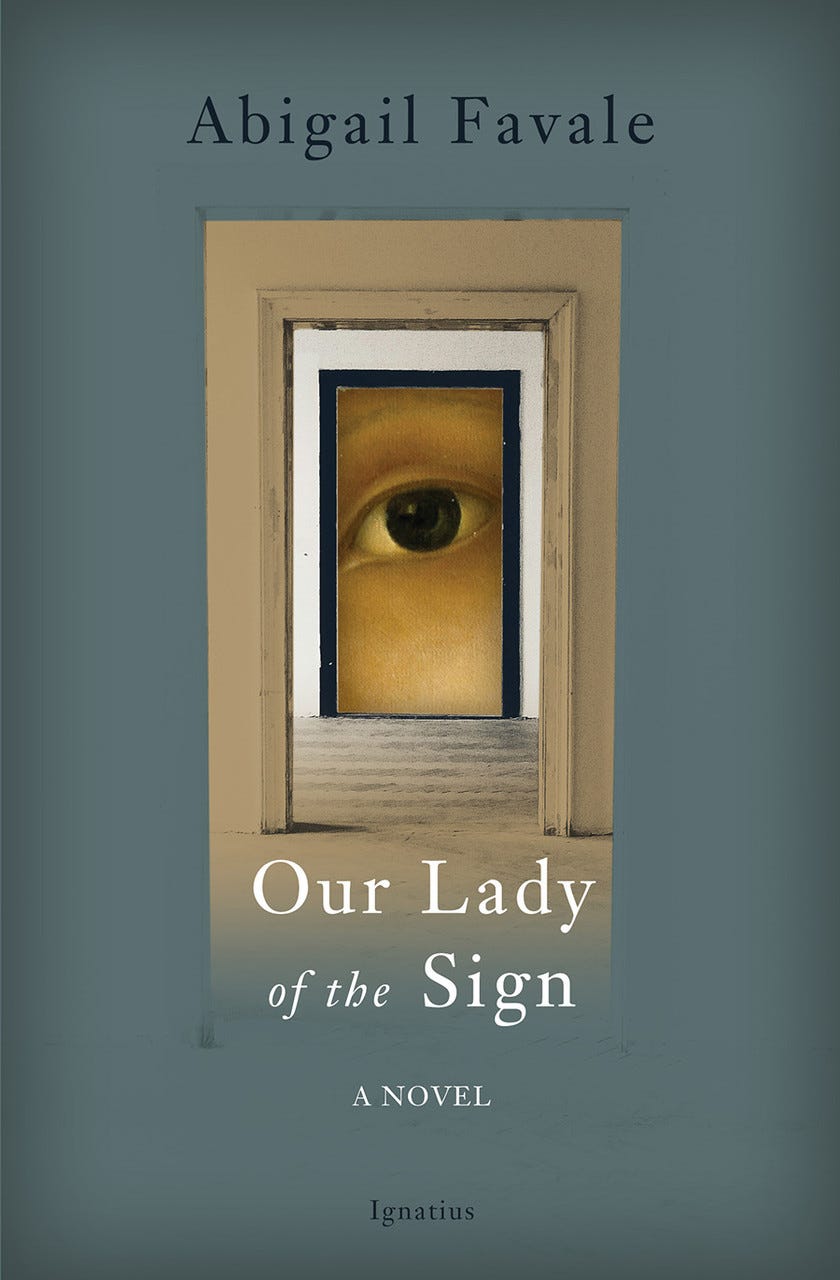
Our Lady of the Sign by Abigail Favale (Ignatius Press, 2025)
Reviewed by Jennifer Nundal
Abigail Favale, academic, theologian, and autobiographer, has published her debut novel through Ignatius Press. Our Lady of the Sign is a semi-surrealist work centred on the story of an atheistic college professor, Simone Stark, who embarks on a journey to visit the far-flung town in Idaho where she spent her adolescence. There, contemplating the need for an abortion for the second time in her life, she experiences a series of demonic encounters while reuniting with the figures of her past. These disquieting events, which constitute the majority of the novel, guide her on a journey to the discovery of true freedom.
“Yes.” The word rises easily from within her, up from under her heart. She says it again. “Yes, I promise. Yes.”’
This resounding ‘yes’ is the note upon which the novel ends, echoing the Marian fiat in keeping with the deeply Catholic tone of the entire book. The novel aims to draw the reader into Simone’s conversion as she gradually relinquishes her attempts to control the direction of her life through an abortion and an affair with a past lover; these are superseded, ultimately, by the final abandonment of herself to a burgeoning new existence, which will bring with it a child, shared with her boyfriend Peter who awaits her back home.
The subject of conversion is undeniably a beautiful one, and has been meaningfully explored by Favale in her autobiography Into the Deep (2018); however, here as the theme of a work of literary fiction, it fails to convince. The preponderant issue lies not so much in the quality of the prose—Favale is a competent writer—but rather the medium in which she has set out to elucidate her particular vision of a Catholic theological anthropology. This rich theological framework, expounded upon by Favale in her academic work The Genesis of Gender (2022), and the conversion story so powerfully told in her autobiography, appear again in Our Lady of the Sign as the heart of the novel. Here, however, the message of conversion and the call to explore more deeply the physical and spiritual dimensions of femininity are far less compelling when woven into this fairly transparent fictional narrative. Of course, literature is more than capable of conveying a worldview or belief system to the reader; great fiction, nevertheless, ought first and foremost to transport the reader into its own world—a world very much like our own, or perhaps not like it at all—before releasing them, hopefully changed, back into their own. “In Our Lady of the Sign, one feels oneself jolted back and forth continuously between the events of the narrative and a university classroom in which Favale qua academic is lecturing. In other words, in failing to leave her own academic voice out of her novel, she also fails to create an entirely believable fictional world in which the reader can lose herself. One is prevented from having any chance of becoming absorbed in the story due to an excessive number of intellectual guideposts.”
“Perhaps this was the moment, the call to adventure, that initiating moment of the hero’s journey. She’d taught it so many times in Lit 101, that archetypal narrative pattern that appears in every culture, every great story: the hero’s journey. And it begins with the call to break out of the confines of ordinary life, and into something more. Many try to resist the call. The risk is too great. What will be her answer?”
It is not altogether easy to express the impression left upon the reader by excerpts like this one. The transparent foreshadowing feels ungainly and rather didactic. In her essay, “Fascinated to Presume: In Defense of Fiction,” Zadie Smith summarizes the ends of fiction as having much to do with empathy, and the writing of it as being an exercise in a fascination with—and presumption about—that which is other than us. In other words, writing fiction involves the creation of characters quite possibly as unlike the author as can be, but with stories which draw on the wealth of emotion which is the inheritance of all human beings. It is in the feeling of human feelings, felt on behalf of another, that the power of fiction consists. Smith argues that our current culture challenges this view of fiction as empathetic, speculative, and other-oriented, and rather asks the writer to refrain from pretending to understand others, and to write instead only about herself, or someone very like herself.
The character of Simone shares undeniable parallels with the author herself. An unbelieving feminist academic, unsatisfied with her life, finds herself in a push and pull romance with the allure of Catholicism: this is Favale’s story as much as it is Simone’s. Hence, it is as difficult to argue with this novel as it would be to argue with Favale about the genuine sincerity of her own story. How can one say she is wrong, or challenge her assumptions, when she knows this story through and through? It is thus that the reader finds herself in a position where, while she cannot disagree with the neatness or plausibility of the story, she does not, to once again draw upon Smith, “believe in the imaginary people… placed in these fictional situations.” The story does not grab, nor is it truly open to the reader’s unique and intimate interpretation and relationship to it; like Favale’s non-fiction, it feels factual even in its sentiments. It is fruitless to argue with such facts, but one also feels nothing for them. Consequently, the novel fails to argue itself into the reader’s heart, as all great fiction is wont to do.
“Virgin and mother at once, she thinks. An impossible ideal. She remembers her graduate seminar in medieval literature, the cult of Mary, her professor’s conviction that Mary was a male fantasy, brilliantly concocted to control women while seeming to elevate them.”
Again, the reader is jolted from the narrative. The purpose of such passages feels purely instructive, spelling out repeatedly an unambiguous message intended for the reader. Later in the novel, a page-long description of an icon of Our Lady of the Sign drives home the novel’s imagery and message again, with rather a heavy-handed force. Ultimately, one cannot escape the feeling that even the reader’s intimate, deeply personal reaction to the characters and ideas in the book has been preordained and must thus be carefully directed throughout. In her eagerness to share her convictions, Favale seems to have sold the characters of her story short; often, they feel more like mere tools employed in the delivery of her message than real, living people. Herein lies the fundamental flaw which prevents Favale’s novel from being a great work of fiction, as worthwhile as it may be in its many components.
It is necessary to conclude with the admission that this novel was difficult to review. Favale is here, as in all her works, a clear thinker with a genuine talent for writing. Her gift for centering an intensely female experience in a Christian context is no small thing, and is much needed in our times. Should she continue to write novels, confessional or otherwise, it is only hoped that she might more completely abandon her academic proclivities and engage more boldly with that which is unlike herself, allowing for a fiction that truly transports without reservation.
Jennifer Nundal resides in Langley, British Columbia.
Abigail Favale, Ph.D., is a writer and professor in the McGrath Institute for Church Life at the University of Notre Dame. A Catholic convert with an academic background in gender studies, Abigail writes and speaks regularly on topics related to women and gender from a Catholic perspective.
Abigail’s memoir, Into the Deep: An Unlikely Catholic Conversion, traces her journey from evangelicalism to postmodern feminism to Catholicism. Her essays and short stories have appeared in print and online for publications such as First Things, Public Discourse, The Atlantic, Church Life, and Potomac Review. She was awarded the J.F. Powers Prize for short fiction in 2017. Favale lives with her husband and four children in South Bend, Indiana.
I agree with these points. I would add that there were no surprises in the novel, everything followed quite to formula, which made it forgettable. The prose was quite bright in several places, but the story was lacking in imagination. I look forward to Dr. Favale's second novel since, as you note, she has talent. Perhaps the next go will be better.