


Named and Nameless by Susan McCaslin (Inanna Publications, 2025)
Reviewed by Liv Ross
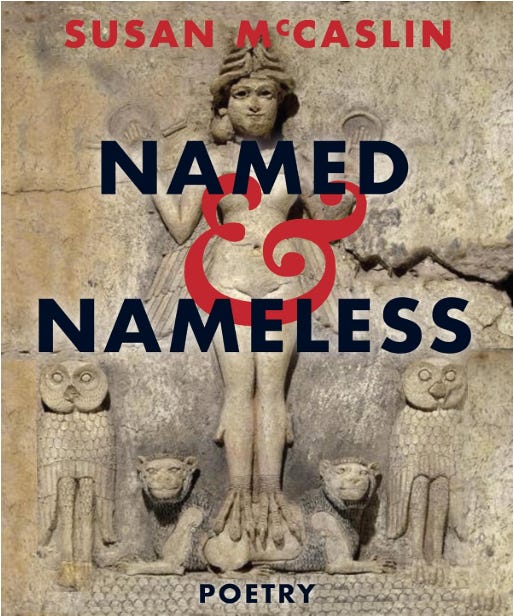
When I first pick up a book of poetry, I like to spend some time with the cover and the table of contents to get myself familiar with the art and feel of the book: the way the poet decided to break and name sections, the titles of the poems themselves. This helps give me a guide to what story the poet is spinning throughout the collection, if they are spinning one at all. One blurb told me McCaslin was exploring identity and significance in these poems. I saw several anchoring points to ancient myth and story with titles like Selene Disappearing, Merkabah Mystic, Gaia, Inanna, and This Time Persephone Draws Demeter Back. Throughout, I spied several references to historical figures such as Copernicus, Lao Tzu, and Nefertiti. There were also many poems dedicated to birds, trees, and other members of the natural world. The collection of 78 poems is broken into three sections: Naming, Naming & Unnaming, and Named & Nameless. There was a tide-like cadence to this, and a progression that I found intriguing. All of these facets interested me deeply as I began to read the collection.
When I dug into the poetry itself, I found that it was made up of free verse poems which deal sincerely with their subject matter. Whether McCaslin encounters a woman’s morning routine, a particular penmanship, or a Northern Flicker, she seems to attend to the subject carefully. Attention is a critical skill for a poet, and McCaslin has it for the world around her, but I didn’t find this care quite extended to the form of the poems she produced, either individually or in the collection as a whole.
While the collection was broken into three distinct sections, I couldn’t find any thematic clues as to why poems were placed into the sections they were. The poems could have been placed in a completely different order, and I don’t think I would have noticed an effect on the overall composition of the collection. The cover art and summary, and the poem titles had so many themes of light and dark, gaining and losing identity, history and the present day. I was expecting to be taken on a sort of katabasis. It is true that I found elements of that in individual poems, most obviously in the lyrics to Inanna and Persephone. The final poem in the collection “Inanna Enters Oneness” has this, and would have made a decently strong ending if I felt the journey to get there had been a little more thoughtfully laid out.
I noticed that the subjects of the poems tended to fall into one of three categories: interior contemplation, natural world observations, and mythological reflections. They were scattered throughout all three sections. The collection might have been served by grouping them together in a kind of rippling pattern, inward to outward, or removing the sections altogether to communicate the interweaving of person, nature, and story.
For the individual poems, as I said, the care and attention given to the poetic subjects often didn’t extend to the crafting of the poem itself. More than one reads like fragments gesturing toward a poem rather than something complete.
Some of this, I did feel, was an intentional stylistic choice from McCaslin. Aside from titles and epigraphs, there are no capitals or punctuation present in the poetry. These are free verse poems entirely, with one instance of a nod at rhyming in “From the Great Above She Sets Her Mind on the Great Below”:
she doesn’t do it for glory
doesn’t go down for fame
it isn’t for enlightenment
she lays her hands in the flame
stumbles alone down the stairway
stripped of her lapis and crown
stands bereft in the darkness
deep in the darkness is bound
The poem goes on for six more unrhymed couplets, but there were no other instances of rhyme, and none at all of meter. Neither in this poem nor in the collection as a whole. The general lack of structure and a tendency to list objects or feelings made several of these poems feel more like a series of observations that could turn into poems if given a little more time and thought. Take the poem “To What Is”:
open us to our nonhuman siblings
who share with us this blue sphere
owl   whale of wide-lunged passion
wolf of burning mandala eye
walk to a field where we are
fleshed   blessed
falling waiting
in a transparent ring
a garden
of humus, water, air, fire
There are flashes and images, but nothing to really help it all cohere.
“Selene Disappearing” is another poem that starts with some strength, and its issues illustrate the pattern across the collection. It is almost a palindrome poem.
calls
up
a deeper
ethos
where beauty
still transmogrifies
the mooning
heart
still drifts
where beauty
ethos
a deeper
up
calls
It is almost a concrete poem, with the visual sense of the waxing and waning of the moon, but the poem doesn’t quite commit to this. The middle three couplets throw it off. It is almost an ekphrastic poem, and it works harder to achieve this. The final five lines are exact reversals of the starting lines, but meaning is sacrificed for the aesthetic. The ideas are interesting, but ultimately incomplete in their execution.
I do want to give credit to several instances of fun word play: “a tree whose only sentence is sentience” in “Who Is She?,” or “on tables and tablatures of the sky” in “Lined Visage,” or “writing rights and singing” in “Her Childish Left-handed, Back-handed Script.” The use and placement of these kinds of word pairings linger as they close out their poems, helping them stick a little more in the memory, and even lending some strength where the rest of the poem is a little thin.
I re-read this collection a handful of times because of these flashes of interest and care. I hoped that re-reading might help pull them together into something cohesive that I had missed the first time. It just never quite managed to do so. There are diamonds here, but they remain rough and half-buried.
Bio of Reviewer: Liv Ross is an urban monk, a poet, and essayist writing in and from the Ozarks. In addition to writing, Liv practices gardening, pipe-smoking, leather-working, music-making, and mischief. She has been published in The New Verse Review, The Front Porch Republic, Silence and Starsong, Solum Journal, and VoeglinView. She also serves as Managing Editor for Traces Journal. Her first book, The Blackbird Ballad, is scheduled for publishing May 2026 from Solum Literary Press. She can also be found on Instagram @liv_ross_poetry, or her substack, https://substack.com/@theabbeyofcuriosity.
Bio of Author: Susan McCaslin is a poet living near Fort Langley BC who has been writing since the age of twelve when she discovered the magic of poetry and the power of poetic language. She is drawn to ancient mythologies and the mystical traditions of many cultures and religions and experiences poetry as musicality arising from silence. She has authored nineteen volumes of poetry and twelve chapbooks.