

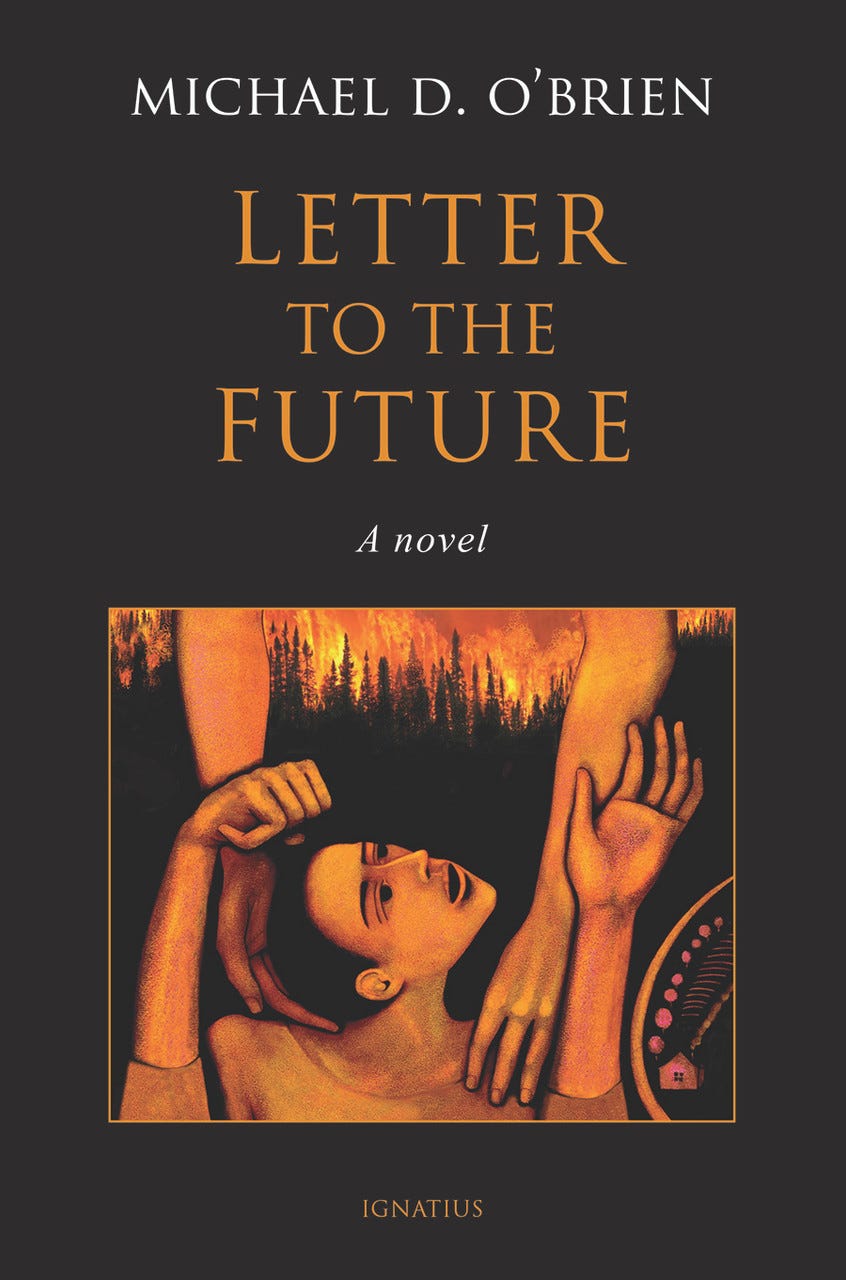
Letter to the Future by Michael O’Brien (Ignatius Press, 2025)
Reviewed by Jack Green
Reviewed by Jack Green
Are you ready for the Apocalypse? That is one of the questions Michael D. O’Brien pursues in his latest novel Letter to the Future. Indeed, it is one that resounds through most of O’Brien’s novels, particularly the Children of the Last Days series. In this latest work, he voices the question through two letters written by Cleveland (Cleve) Longworth to the ‘children of the future’ – those living after the apocalyptic ‘catastrophe’. These letters are discovered in Part I, some centuries after they had been written, by children belonging to that new age. Translated by an ingenious priest from the English in which they were written to the unnamed language of this new age, the letters record Cleve’s version of the events that radically alter the world, history, and every human heart.
In the first, longer letter (Part II), Cleve records something of his life leading up to the ‘catastrophe’, but focuses on the two days which initiated the new age. Civilisation collapses at some velocity during those days, though through a cause unnamed. This is deliberate: O’Brien attempts in the novel, as in others, to steer attention away from the material causes of history to the spiritual principles at work and the drama played out in the heart of each character. We are given some insight into this in Cleve himself and in the mixed bag of strangers and friends that he accumulates as he seeks shelter from the cosmic disturbance.
The second, shorter letter (Part III), something of a post-script to the first, contains the reminiscences of Cleve at the end of his earthly days, turning over in his memory the decades
that followed the catastrophe. Here we follow the purgation, consolidation, and propagation of Cleve, his family, and his fellow apocalyptic sojourners as they build, under a new heaven, a new earth. O’Brien leaves it to us to fill in the timeline from Cleve’s small, post-Apocalyptic community to the children of the future who discover his letters, though there are a few clues of continuity sprinkled throughout the novel – not least that the children who discover the letters are Longworths. Rather than offer a neat chronology, O’Brien leaves us with some “ultimate thoughts” about Providence, our place in it, and “God’s will for us.”
Some readers, it is true, may perhaps find the Christian themes too ‘on the nose’ and lacking a certain degree of subtlety. For example, the ‘holocaust’ – one of the harrowing apocalyptic events unleashed upon Cleve and company – is an imaginative redescription of the dubious Three Days of Darkness prophecy, usually accredited to Italian mystic Anna Maria Taigi. Its presence is barely concealed. Furthermore, O’Brien’s theological and philosophical musings, which permeate earlier novels, have a less ponderous pace and contemplative tone here (despite the philosophical Rafe, Cleve’s boss, mentor, and friend); most of the conversions that occur in the novel, for example, do so in but a few lines, and even Cleve’s feels fast. The theological, at times, lacks finesse.
However, O’Brien has always foregrounded thick Christian themes. The imaginative labour is, for him, a fruit of contemplation, which does not occur in a vacuum but rather in a Catholic Tradition mediating forms and figures to him, which inevitably spills over into poesis. In that sense, the novel, and much of O’Brien’s literary work, is a counter-weight to the silencing of theological themes in famous dystopias of the previous century. Such silence, in its own way, is a most disturbing dystopia, which O’Brien robustly rejects.
That said, I would submit that this is not O’Brien’s most skillful work of Christian art. As the title suggests, time and history are recurring themes, but the timing of the narrative is arbitrary and uneven: we are thrown forward centuries in Part I, then pulled back to something like our present and held, over most of the novel, for but a few days with Cleve. Then, almost as if the narrative has lost steam, we skip over the remaining decades of Cleve’s life in the concluding post-script. The temporal jolting serves no discernible purpose, and it may have proved better for O’Brien to offer a novel of a more characteristic length. This would have allowed him time to develop some of his more interesting characters (like Rafe) and themes (shelter) with the sophistication and subtlety that one is used to with O’Brien. Too much is too cursory, and while the Apocalypse would understandably provoke haste, O’Brien has been able in other apocalyptic novels (most famously Father Elijah) to mix pace and depth quite evenly. To get a better sense of O’Brien’s tremendous skill as a Christian writer, one would be better to look to his Children of the Last Days series.
Nevertheless, O’Brien knows how to get a reader to turn the page, and this is undoubtedly a page-turner. All the while one is provoked to wonder where this world is heading, where it could go (and is going) wrong, and, more provocatively, whether one is prepared to live under Providence. O’Brien does a fine job to frame this without fear, but in peace and simplicity, speaking of such a life, in one of the most beautiful phrases of the book, as “doing the duty of the moment.” The work may not be one of O’Brien’s best, but it is a book for this moment and for the children of this age.
Jack Green holds degrees in philosophy from the University of Notre Dame (Australia) and degrees in theology from the Sydney College of Divinity and the University of Oxford, where he is currently completing a DPhil in theology.
Michael O’Brien, iconographer, painter, and writer, is the popular author of many best-selling novels, including Father Elijah, Strangers and Sojourners, Elijah in Jerusalem, The Father’s Tale, Eclipse of the Sun, Sophia House, The Lighthouse, and Island of the World. His novels have been translated into twelve languages and widely reviewed in both secular and religious media in North America and Europe.