


D.S. Martin is Poet-in-Residence at McMaster Divinity College in Hamilton, Ontario, the Series Editor for the Poiema Poetry Series from Cascade Books, and serves on the Advisory Board for Traces. His new poetry collection The Role of the Moon (Paraclete Press) is a Gold Medal Winner at the Illumination Book Awards, and a Finalist for the 2026 Poetry Society of Virginia North American Poetry Book Award.
D.S. Martin was interviewed by Burl Horniachek on March 16, 2026 by video conference. The transcript was then edited and expanded by both of them.
Burl Horniachek for Traces Journal: Welcome to Traces, Don. Could you introduce yourself a little bit and tell us about your new book?
D.S. Martin: Thanks, Burl. My name is Don Martin; I go by D.S. Martin in my writing. My newest book is called The Role of the Moon and it is published by Paraclete Press. One of the primary focuses of this new book is the metaphysical poets, particularly John Donne. I have 19 poems in this book which are in conversation with each of Donne’s 19 Holy Sonnets. I also have poems in the book relating to George Herbert, Thomas Traherne, William Shakespeare and then I also go into the 19th century with Gerard Manley Hopkins, Emily Dickinson and Elizabeth Barrett Browning. These are some of the influences on the book.
This is my fifth full-length poetry collection. I’ve been involved with several other things as a poet through the years, including my long-running blog Kingdom Poets, where I post every week about a Christian poet, and have done so since February of 2010. I am privileged to be the Series Editor for the Poiema Poetry Series from Cascade Books, where I’ve edited more than fifty collections by some of the best poets of faith out there. I also hold the role of Poet-in-Residence at McMaster Divinity College.
Traces: When did you first encounter poetry? And, more specifically, some of these poets you engage with in your new collection?
D.S.M: Well, when I first encountered poetry it was through simple children’s poems, for example, “They’re changing guard at Buckingham Palace —/ Christopher Robin went down with Alice” from When We Were Very Young by A.A. Milne, which I was reading to my grandson this weekend.
I would put the greatest influences for me, growing up, into two categories: one was singer-songwriters. I was very much into music and very much into paying attention to the lyrics, and, as time went on, I found that even some of the best songwriters had clunkers now and then, because, of course, there are many different aspects to what makes a good song, or makes a song that draws you in, and songwriters know that. So, it’s not always merely poetry. Sometimes I would hear a song by a very good songwriter and really groan. I believe that’s what drew me towards looking into books of poetry.
Another thing that influenced me a lot was being raised in an Evangelical church under the sound of the King James Version of the Bible. The music of the King James particularly spoke to me. I would also say that the whole attitude about how valuable words are also touched me, because in evangelical sermons, especially expository sermons, sometimes one very small word is of great importance. So, the importance of individual words, that each word matters, came to me from that heritage too.
Traces: You mentioned music and song lyrics and some of the poems in your books are responses to various musicians or pieces of music. Are you a musician yourself? Do you play any instruments?
D.S.M: I would never call myself a musician although I’m very musical; my youngest son has inherited that, and he’s quite a musician. When I was growing up I was not very disciplined, partly because I believe I had, or even have, ADHD, and, therefore, to stay focused and to be disciplined in something like learning an instrument was not something natural to me. When I was about 14, I taught myself harmonica, and I can play quite well by ear, but that’s hardly something that compares with some of the fine musicians out there.
Traces: I ask because there are a couple of your poems, “On a Summer’s Day” and “Piano Lesson,” about how the musician has to learn by practice and discipline, and then he can kind of let go. Is that from observing others doing musicianship, perhaps your son, or other people?
D.S.M: Yes, that’s personal and observed. I can’t really place a finger on that precisely, but I would agree with what you’ve said.
Traces: A number of your poems are also in response to works of art or movies. But you have also written poems about specific musicians. There’s a poem to George Harrison and one to Hank Williams. Why did you pick those particular musicians?
D.S.M: I suppose in some ways they could be fairly random, in that they’re significant musicians, no doubt, but I probably could have chosen dozens of others in the same context. The one for Hank Williams is in my collection Angelicus, where I have one of the angels looking at Williams’ life and what he went through. I find that as I’m listening to music, as I’m thinking about music, and as I’m learning about different people, sometimes their stories touch me. I think the Hank Williams poem is a good example. It’s the story of the character and the character moves me because of the music that has moved me.
The George Harrison poem, though, is not really focused on Harrison’s life. Like the others in Conspiracy of Light, it was influenced by C.S. Lewis. Of course, Lewis was not somebody who would have appreciated contemporary music. He died in 1963, so that was before rock and roll had really developed an artistic side. Part of it is how that particular poem speaks about Wordsworth and van Gogh, but then I bring in something I don’t think Lewis would have appreciated specifically, but still fits what his concepts talk about:
Some people though would trip over such a form
wouldn’t catch anything from an electric guitar
like Jack Lewis whose tastes were of times long gone
Because Lewis very much was a man of the past, he was very much a 19th century man living in the 20th century. So, some of the things that I love would not have been appreciated by Lewis, and yet I still appreciate him very much.
Traces: The reference to 1963 kind of reminds me of Philip Larkin’s poem “Annus Mirabilus” and how Lewis didn’t live to see the full flowering of 1960s culture and how we can only imagine what his response would have been. Now, when you were putting together Conspiracy of Light did you start off with the idea of writing a whole book of poems responding to C.S Lewis?
D.S.M: I really didn’t at first. When I was younger, in my teens and early 20s, I had read everything by Lewis I could get my hands on; I was just fascinated by him. Then, I moved on to other things and I hadn’t read him for a long time. I then just decided to pull Mere Christianity off my shelf and read it, and what struck me was how many of the thoughts inside me, that I had thought were my own, were really Lewis’s ideas that I had internalized.
He was so good at writing analogies: things from the unseen world, things of the spirit, which we can’t talk about from human experience; he would come up with analogies that were perfect. So, some of what I did in Conspiracy of Light was take one of his analogies and then run with it, expand it out into a whole picture or a whole landscape. I just fell into that and it was very exciting to do so, because Lewis is so profound, and so are many of the things that he said and did. It had not originally been a plan. It just happened and I couldn’t resist.
Traces: C.S. Lewis’s own poetry is not usually considered among his best work. You’ve said to me before that he often tries to incorporate too much argument into his poetry. But, in Conspiracy of Light, you include a trio of poems (“Proof,” “Thirst,” and “Apologetics”) which, while they don’t really have a full blown argument to them, do kind of gesture towards an argument. Can you say something about how you managed to do that, without turning them into essays.
D.S.M: Well, I really do believe that poetry is not the place for arguments. For a poet to try to win an argument in a poem basically undermines the poem itself. I believe that what a poem should do is present ideas and leave them for the reader to think through. So, yes, I like that term you used, gesture. I gesture towards his arguments, because he often said really profound things. My poem “Thirst” arose from a section in The Great Divorce:
“‘There was a time when you asked questions because you wanted answers, and were glad when you found them. Become that child again: even now.’
‘Ah, but when I became a man I put away childish things.’
‘You have gone far wrong. Thirst was made for water; inquiry for truth…”
I took that line “Thirst was made for water; inquiry for truth” and I created lines that seemed like they might be following an argument, but in fact they don’t. They circle all around and paint pictures, and I think that works, because then people can think for themselves, and decide “Well, what might this mean? What’s going on here?” That’s what I seek to do.
Traces: Another aspect of Lewis’ work is his literary criticism, and he was, in particular, an important figure in what might be called the mythological school of criticism, along with some other, somewhat different critics, including Northrop Frye here in Canada. One of your other poems in Conspiracy of Light is “Truth in Myth,” where you go through a bunch of different mythological analogies or types of Christ found in earlier non-Christian stories. Tell me about how you came to write that poem.
D.S.M: With Conspiracy of Light, I wanted to try to get at every aspect of who Lewis was. I’ve encountered Christians who don’t want to hear anything about mythology, because it’s pagan, but, in fact, Lewis saw that there was truth in the myths. There’s a letter Lewis wrote to Arthur Greeves that’s in the Alan Jacobs’ Lewis biography The Narnian. It goes like this:
“Now what Dyson and Tolkien showed me was this: that if I met the idea of sacrifice in a Pagan story I …was mysteriously moved by it: again, that the idea of the dying and reviving God (Balder, Adonis, Bacchus) similarly moved me anywhere except in the Gospels… Now the story of Christ is simply a true myth: a myth working on us in the same way as the others, but with tremendous difference that it really happened: and one must be content to accept it in the same way remembering that it is God’s myth where the others are men’s myths: i.e. the Pagan stories are God expressing himself through the minds of poets, using such images as He found there, while Christianity is God expressing himself through ‘real things.’”
The idea of these myths coming true in Christ was very much something that influenced Lewis to come to faith. I wanted to get at and play with that in my poem “Truth in Myth.”
Traces: I’ve noticed that images of lakes often recur in many of your poems. There is one from your first collection just called “The Lake,” but I also think of “A Summer’s Day” and “Moon Landing” in your second collection. Could you tell me more about the role that direct contact with nature has had in your poetry, or just your life in general?
D.S.M: It’s an interesting question to try to think about, because the place we are living, the things in our environment aren’t just the things we see, and are things we often take for granted. I remember, growing up, so often in the summers going to different lakes. My parents had a trailer, and we had a cottage for a brief time, and those times and experiences are very rich. I also grew up in the west end of Toronto, which was still an area of unmanicured fields and semi-wild places, and I would often go for walks down by Etobicoke Creek, which wasn’t far away, just to be in nature. So, even though I was living in the suburbs, I could get to nature very quickly and find water and trees. Later, I loved to go hiking with friends along the Bruce Trail. My wife and I love hiking, and now we live very close to the Thames River, just outside London, Ontario. Those things become images in my toolkit for poetry, so they come up often. Those are places I love to be and things I love to experience.
Traces: You mentioned before that you grew up in an Evangelical church and that the Bible was an important part of your early literary experience. Many of your poems are responses to various Biblical stories. How does one particular story in the Bible grab you and make you want to write a poem about it?
D.S.M: Good question. I think it usually is a case where I come to the story and I’m not quite sure what I’m thinking. It raises questions as much as anything. So, I’m trying to find my way through the story, whether it has to do with understanding the character, or why God would do something in particular.
I don’t tend to write poems about the known, so much as what I’d like to know, or what I’d like to figure out, as opposed to what I’ve already figured out. I find poetry writing is a great process for getting at truth, because when you write a poem you’re forced to be honest. If you’re just writing something devotionally, you might let yourself off with the way you’re supposed to feel, or what you’re supposed to think. But, when it comes to a poem, you’re forced into a deeper sense of honesty, which makes you go deeper into a topic.
Traces: Occasionally, you’ve written poems in response to films. You have a poem where you talk about how C.S. Lewis wasn’t really favorable to most film adaptations, but you also have one in Angelicus about Frank Capra’s It’s a Wonderful Life. How is it different to write a poem in response to a film as opposed to another text?
D.S.M: Well, in the Angelicus poems, I’m writing from the point of view of angels, and in that poem an angel watches It’s a Wonderful Life. I’m having fun with it. That is, I’m asking how an angel might perceive this movie, because, of course, it’s not very accurate in its portrayal of an angel. Actually, a number of times within that collection I have my angels getting rather perturbed with the way we humans portray angels. So, I’m being playful.
Traces: Again, did you start out with the idea of writing a book of poems from the perspective of angels or about angels?
D.S.M: I began simply by writing one poem. I was thinking how I would like to write poems from a perspective other than my own. The first one I wrote in that series is called “An Angel’s View of Automobiles.” It’s basically taking our ordinary experiences and seeing what it might be like through the eyes of an angel. One thing poets do is we take the familiar and make it strange, so that we can see things in a new way. And that poem attempts this in a playful way. So, I continued from there with a few others, and then more and more ideas delightfully came to me, until I realized an entire collection was going to come out of it.
Traces: One of my favorite poems of yours is from Angelicus, “An Angel from Signorelli’s Resurrection of the Body.” Obviously the poem is inspired by the specific painting, but what else went into composing that poem?
D.S.M: This was a delightful experience. I was actually in Orvieto, Italy teaching a course in ekphrastic poetry — which is poetry written in response to visual art. In the San Brisio chapel in the Duomo of Orvieto is this amazing painting, “Resurrection of the Body” by Luca Signorelli. I got to stand beneath it for a long time and just pay great attention to it, and then to write this poem, and then to come back and go over it, looking back at the painting itself. It’s a very large painting on the wall in that chapel, so it enabled me to really feel Signorelli’s capturing and interpretation of the scene. Now, obviously my poem is inspired by the painting, but a poem is never primarily a picture…
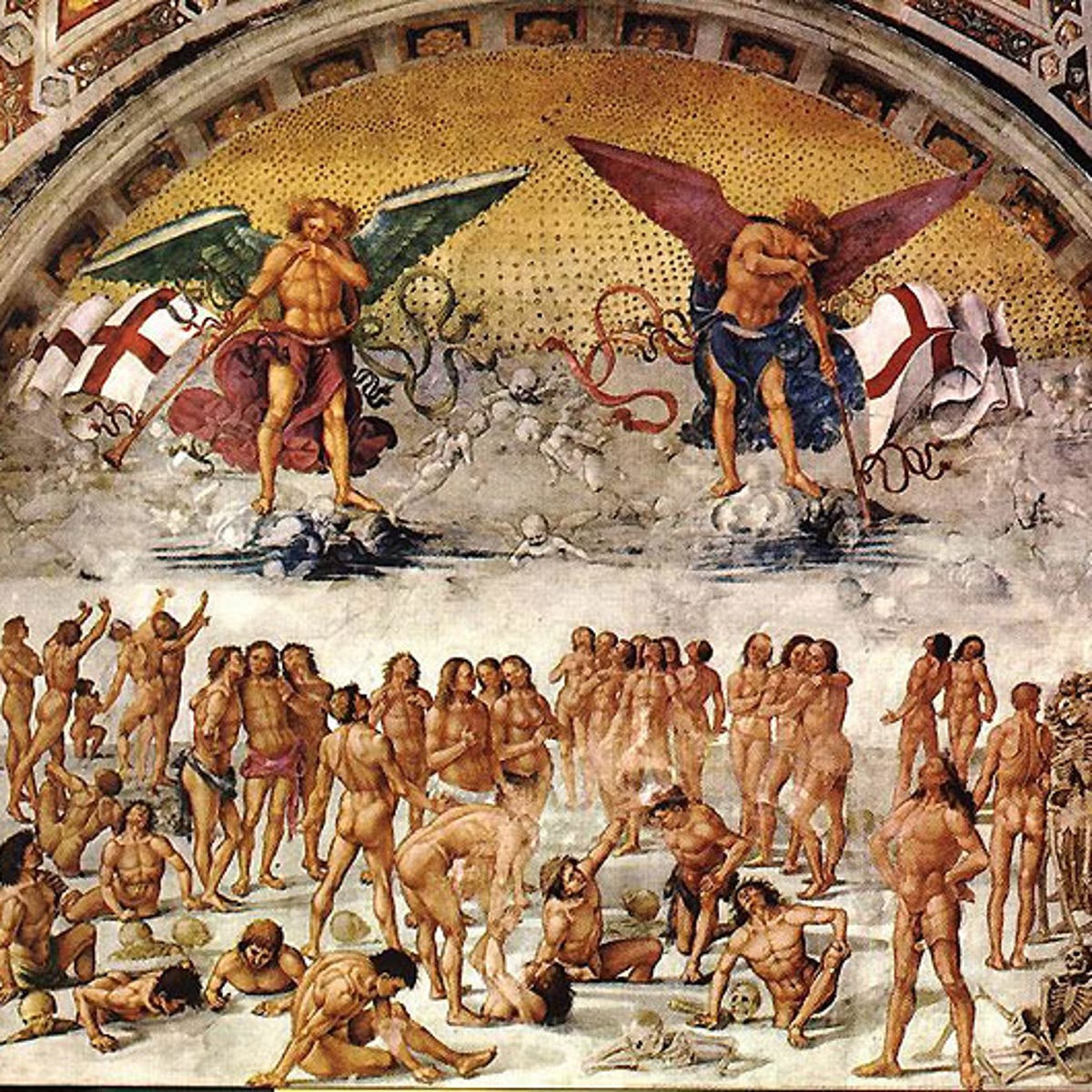
Traces: Yes, there is a striking use of particular words in this poem. I don’t think I’ve ever heard the word “disdiseased” used before. Just the use of that one particular word elevates the whole poem. There’s also the image here of the resurrected as they pull themselves up like swimmers pulling themselves up onto a summer dock. Again, in that one image you’re moving from a painting to the actual resurrection to a lakeside here in Canada, and I found that swift movement, all at once and in one phrase, quite wonderful. Do you have anything more to say about that particular image?
D.S.M: Simply that this one character from the painting who was pushing himself up and out of the ground looked exactly like when you’re putting all your weight on your hands pushing yourself up, trying to get out of the water. It was a gift really, in that picture, because it fit the summer dock image perfectly.
Traces: There are a lot of other resonances too. Death is often depicted as water, so coming up out of death is a lot like coming out of water. Even though the character is coming out of the ground in the painting, it’s almost like the ground itself has been liquefied. Maybe you didn’t even think of some of these things when you were writing, but it seems to me a lot is coming together there.
D.S.M: Yes, it just all came together. It was just right. As I was constructing it, it just seemed to ring true, both to what was in the painting, but also to my own experience, and what I’ve seen and heard and done.
Traces: I wanted to talk a bit about the new book. In your previous books there have been a few poems about birds. In particular, there were a couple poems with eagles, and eagles, of course, like sparrows, are birds with Biblical resonances. But in the new book you also have falcons and ospreys and others. What was the reason for so many bird poems? Do you have any particular affinity for birds? Or was it just Biblical imagery? Or something you picked up on from Gerard Manley Hopkins?
D.S.M: Well, many interrelated things. I do have a bird feeder behind our house and I do value chances to share in the birds and experience them. But there are also other things. For example, the osprey makes me think of a place where we would often go in the summer, where there were osprey nests by the Trent Canal. I saw a pileated woodpecker yesterday when my wife and I were out for a walk. They’re very large woodpeckers. But also, since we moved to the London area last May, I’ve seen bald eagles three different times. Those things are appealing to me. From doing lots of hiking, from being out on the water, from having a backyard bird feeder, those things come together to allow bird images to play in my mind. Birds are fascinating creatures, able to do what we cannot; there are so many of them, we take them for granted, and then suddenly they’re there and we are filled with wonder.
Traces: I was particularly struck by your poem about the Peregrine Falcon in your latest book. The fierceness of the bird there reminded me of a couple of things. Perhaps the most obvious is the fierceness of some of the birds in Gerard Manley Hopkins, but I also hear the very fierce God of John Donne’s “Batter My Heart.” Could you talk a little bit about Donne and Hopkins, where you first encountered them and what their influence has been on you?
D.S.M: Certainly. When I went to the University of Waterloo as an undergrad, I was really impressed by how certain poets — obviously Christian, obviously passionate about God — were being discussed in a secular university. It struck me how powerful some of these poems are. John Donne particularly hit me. I could talk about John Milton or a number of other poets, but the Holy Sonnets impacted me particularly at that time. Then, through the years I’ve spent quite a bit of time trying to meditate on the Holy Sonnets and some of Donne’s other writing. These poems speak of the poet wrestling with God and wrestling with himself and with his own inadequacies and trying to understand what he doesn’t yet understand; and that is, as I’ve already mentioned, something that appeals to me. Writing a poem is to try to discover what I know by looking at the world — and John Donne did that extremely well.
In this particular poem I’m taking the image of the peregrine falcon who shouldn’t be able to do what it does. At the speed that they travel their eyes should dry out, their lungs should rip open, but that doesn’t happen. Why? Because God’s designed them. Now, I don’t just go into that in the poem, but I turn it around and view God as the bird of prey, and my response is not to get away like the pigeon, but to be ready to be consumed, shall we say, by the predator, because that is where true meaning comes: from being in submission to our God.
Traces: Another Canadian poet who was strongly influenced by both Donne and Hopkins was Margaret Avison. Could you tell us a bit about her and some of the other Canadian poets, religious or not, that have influenced you.
D.S.M: I’d say some of my earliest influences were Canadians poets −although not necessarily those who wore their faith on their sleeve. I think of Alden Nolan, who I believe was Catholic. I never did research into him; I just loved the way his poetry worked. Someone like Leonard Cohen, who, although not a Christian, was certainly a man who wrestled with issues of God and faith. Margaret Avison came up pretty early for me as a significant poet. She is described by anybody who talks about her as a difficult poet, that is she’s someone who you really have to spend time with, although I did find through the years that her poems were gradually becoming more accessible. But she would write in such a way that left you with many things to think about, many things to wrestle with, and that made the experience of reading her poetry very worthwhile.
Some other Canadian poets I appreciate, particularly poets of faith include Sarah Klassen, in Winnipeg. I find her poetry to be very inspiring. In fact, I think some of her more recent poetry, as she’s getting older, is actually even better than the excellent poetry she wrote when she was younger. So, certainly a poet to look into and to spend some time with. Another is John Terpsta.
Traces: Not all your poems are about works of art or experiences with nature. There are also some about your family. We’ve already talked about how your musician son has appeared in your poems, but you’ve also written about your parents and their struggles with dementia. There’s one in the new book called “Glorified” and one from Ampersand called “Peace and Quiet.” That is quite a difficult personal subject, but I find them quite moving and wonderful as poems. How do you deal with extremely personal material like that and manage to make poems that other people can appreciate?
D.S.M: Well, one thing is that poetry needs to be specific and immediate. You can’t talk in generalities. We find the universal in particular stories, like the fact that my wife and I spent a lot of time and care looking after my ailing parents. Even though they weren’t staying in our home, we were very much involved in visiting them regularly and looking after their needs. We just found that experience to be consuming. I’m not saying necessarily in a negative way, but just that it was all pervasive and was on our minds a lot. We sought to honour my parents through that difficult time and to be there for them. I mean, to love someone is not to say everything about them is wonderful, but to be honest and true and love them through whatever they’re going through. It was difficult, but things that you live through are bound to come through in whatever art you are producing.
Traces: Thanks for that. Now, I did want to finish things off with a look at something that’s a little bit more mundane. Living in modern Canadian society, you know we’re not necessarily surrounded by extremely poetic or inspiring sights all around us everyday. You have some poems about being in grocery stores and parking lots and things of that nature, and you’ve managed to make a bit of humour out of those sorts of things in your poems. There’s a humorous side to your poetry elsewhere, but some of those really mundane things seem to especially bring it out, like in your grocery cart poems. Could you say a little bit about those poems and about writing humorous poems in general?
D.S.M: Yeah, it’s kind of a funny thing, because when I was younger and writing poems, I didn’t write anything that was humorous at first, even though I was somebody who liked to joke around and, you know, maybe tease my parents or tease my friends or play with puns or things like that. And then, I’m not sure when the change came, but it was quite early in my poetry writing where I realized that every aspect of who we are can shine through in the poetry. And of course, the broader your poetry is, the more things there are for people to identify with. “The Heart of a Grocery Cart is a Wayward Thing” is basically about how you see these grocery carts down in ditches and in creek beds, and I was imagining the grocery cart as being a living thing and playing with that. I could touch on serious things and yet make it playful and funny. Because everyone has seen grocery carts bent and broken and down in the ditch, I think everybody can relate to it, and that’s part of what makes it funny, and also what makes it hit home a little more too.
Burl Horniachek is a Canadian teacher, poet and translator, and the editor of To Heaven’s Rim, a major anthology of world Christian poetry. He was born in Saskatoon and grew up south of Edmonton. He studied Ancient Near Eastern Studies (Hebrew/Ancient Israel) at the University of Toronto and creative writing at the University of Alberta with Nobel Prize winner Derek Walcott. He currently lives near Winnipeg, with his wife, a surgeon, and their two kids.

